

Talent scarcity in niche skills has become one of the biggest challenges for Global Capability
Centers (GCCs) in India today. As GCCs move beyond cost saving roles into advanced work
like AI, cloud engineering, cybersecurity, data science, and product innovation, the demand
for specialized talent has grown faster than the supply. India now hosts over 1,900 GCCs
employing nearly 1.9 million professionals, and this number is expected to cross 2.8 million
by 2030

Modern HR innovation uses AIdriven skill intelligence to map what employees know today and what they can learn next.
These systems analyze resumes, project history, certifications, and even on-the-job
performance to predict future skill readiness with up to 80% accuracy. This allows HR teams
to plan workforce needs months in advance instead of reacting at the last minute. For HR
startups, this shift opens massive opportunities to build tools that support skill-based hiring,
personalized learning, and workforce analytics.
Leading centers now treat talent as a renewable resource rather than a
fixed cost. They invest in structured upskilling programs, internal job marketplaces, and
project-based learning. Data shows that organizations with strong internal mobility fill 25–
30% of critical roles internally and reduce attrition by 20–40%.
Cities beyond metros, such as Pune, Coimbatore, and
Kochi, are emerging as strong GCC hubs, offering lower costs and untapped talent pools.
GCCs that adopt hybrid work and distributed teams report 15–25% lower attrition, proving
that flexibility is now a strategic advantage.
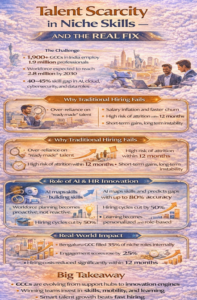
India’s evolving role in global enterprise strategy is clear. GCCs are no longer execution arms;
they are becoming centers of innovation, leadership, and decision-making. Solving talent
scarcity is central to this evolution. The real fix lies in skills-based hiring, AI-powered
workforce planning, continuous learning, and strong internal mobility. For B2B leaders and
HR startups, the message is simple: the companies that win tomorrow will not be the ones
who hire the fastest, but the ones who grow talent the smartest.
Within a year, over 35% of niche roles were filled internally, hiring costs dropped significantly,
and employee engagement scores rose by 25%. This approach aligned business growth with
employee career growth a win on both sides.
The problem is not that India lacks talent. The real issue is that traditional hiring models are
outdated. Many companies still chase the same “ready made” profiles from competitors,
leading to salary inflation, longer hiring cycles, and high attrition. For example, hiring an
experienced AI engineer externally can take 60–90 days, cost 30–50% more, and still carry
the risk of the person leaving within a year.