
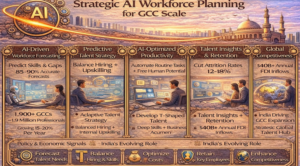
Strategic AI workforce planning is becoming the backbone of how Global Capability Centers
(GCCs) scale in India. With more than 1,900 GCCs and a workforce of nearly 1.9 million
professionals, growth is no longer slow or linear. Many GCCs are expanding at 15–20%
annually, especially in areas like AI, cloud, cybersecurity, and advanced analytics.
AI tools can analyze hiring history, skill inventories, productivity
data, and business forecasts to predict workforce gaps with up to 85–90% accuracy. For B2B
leaders, this means better budgeting and fewer surprises. For HR startups, it opens
opportunities to build advanced workforce analytics platforms tailored for scaling
enterprises.

To grow successfully, companies need to connect their business goals with the right talent.
This means planning 12–18 months in advance and identifying what skills will be needed, such
as AI engineers, data professionals, and compliance or regulatory experts. Instead of hiring
only when there is an urgent need, smart organizations prepare early so they are not caught
off guard.
Today, AI-powered workforce planning tools help companies identify skill gaps before they
become serious problems. For example, many GCCs are currently seeing shortages of around
13% in operations roles, 11% in leadership positions, and 10% in key business roles. When
companies know these gaps in advance, they can decide whether to hire externally, upskill
current employees, or automate certain tasks.
Tier-2 cities in India are expected to hold
nearly 39% of the GCC workforce by 2030. Companies are moving to these cities because
they offer strong talent pools and lower operational costs. This creates opportunities for
graduates beyond metro cities and supports more balanced economic growth.
AI and automation also influence cost optimization. Intelligent automation can reduce
administrative workloads by up to 50%, freeing HR teams to focus on strategic initiatives like
leadership development and workforce design. At the same time, AI-driven workforce models
improve productivity by 20–30%, enabling companies to achieve more without
proportionally increasing headcount.
Many multinational corporations now depend on Indian GCCs to manage
global AI programs, enterprise systems, and innovation pipelines. This positions India as a
strategic partner rather than a back-office hub. Building a scalable, AI-driven workforce
ensures that GCCs can meet global expectations while maintaining competitiveness.
In simple terms, strategic AI workforce planning is about preparing today for tomorrow’s
growth. It helps organizations reduce risks, manage costs, close skill gaps, and scale with
confidence. For graduates, this means entering a workplace where career growth is supported
by intelligent systems.