

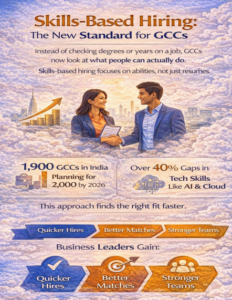
Skills-based hiring is changing how Global Capability Centers, or GCCs, hire new people.
Instead of focusing only on degrees or how many years someone has worked, companies now
care more about what a person can actually do. This makes hiring fairer and more practical
for today’s fast-changing jobs.

Global Capability Centers, or GCCs, in India are changing how they hire. Earlier, hiring focused
mainly on degrees, job titles, and years of experience. Today, that approach no longer works.
With nearly 1,900 GCCs employing about 1.9 million professionals, and talent demand
growing at 18–20% every year, companies are shifting to skills-based hiring as their new
operating standard.
This change is driven by the future of work, where roles evolve faster than degrees can keep
up. New skills like AI, cloud, cybersecurity, and data analytics are becoming critical. Studies
show that over 40% of GCCs face skill gaps in AI and cloud, even when talent is available in
the market. Skills based hiring solves this by focusing on what a person can actually do, not
just where they studied or how long they’ve worked.
For business leaders, this means faster hiring, better role fit, and stronger teams. For
graduates, it means your skills, projects, and learning matter more than labels, giving you a
fair chance to grow in global teams.
Skills-based hiring also supports a stronger talent strategy. Instead of hiring externally for
every new role, GCCs build internal skill maps and promote mobility. Many large GCCs now fill
25–30% of open roles internally by matching employees to projects based on skills. This
reduces attrition by 15–20% and lowers hiring costs.
India’s evolving role in global enterprise strategy makes this shift even more important. Many
multinationals now place global product development, AI research, and platform ownership
in Indian GCCs. These roles demand high-impact skills, not rigid job descriptions.
Within 18 months, the India team delivered 30% faster
releases than earlier distributed teams.
In conclusion, skills-based hiring is no longer an experiment—it is the new standard for GCCs.
It helps companies close skill gaps, reduce hiring bias, improve performance, and retain
talent. For HR startups, it opens doors to build AI-driven hiring and learning platforms. And
for graduates, it means one clear message: your skills matter more than your labels. In the
GCC world of tomorrow, what you can do will always matter more than where you come from.