

India’s Global Capability Centers (GCCs) are at a turning point. With nearly 1,900 GCCs
employing close to 2 million professionals and adding over 300,000 new jobs every year,
India has become one of the most important talent hubs for global enterprises.
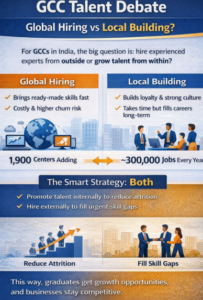
For GCCs in India, the big question is simple: hire experienced experts from outside or grow
talent from within. With nearly 1,900 centers adding around 300,000 jobs every year, many
still face skill gaps in areas like AI and cloud. Hiring from outside brings ready-made skills
fast, but it’s costly and people may leave sooner. Growing local talent takes more time, but it
builds loyalty, strong culture, and long-term careers. The smartest companies do both they
promote and move talent internally to reduce attrition, while hiring externally to fill urgent
skill gaps.

Global hiring works best when companies need special skills quickly, like rare AI experts.
Hiring from outside usually takes about 60 days, while training someone internally can take
up to 180 days. It also brings fresh ideas and global exposure, which can be very useful.
As India’s Global Capability Centers scale rapidly, one key talent question keeps coming up
should companies hire ready experts or build talent from within? This infographic breaks it
down simply. Global hiring works best when companies need special skills quickly, like rare AI experts.
Hiring from outside usually takes about 60 days, while training someone internally can take
up to 180 days. It also brings fresh ideas and global exposure, which can be very useful.
On one side is global hiring. Bringing in experienced professionals either from competitors or
international markets helps GCCs scale quickly. This is especially useful in high-demand areas
like AI, data engineering, cybersecurity, and automation, where studies show over 40% skill
gaps across the industry. For business leaders, global hiring offers speed. Projects move
faster, teams gain immediate expertise, and delivery timelines stay intact.
The smartest GCCs are no longer choosing one approach over the other. Instead, they are
building balanced talent strategies. Critical and niche roles are filled through targeted global
hiring, while the majority of the workforce is developed internally through structured career
paths, upskilling, and leadership programs.
In simple terms, India’s GCC story is shifting from “hire fast” to “build smart.” Global hiring
brings speed, local building brings stability, and together they create a future-ready
workforce. As India continues to strengthen its position in global enterprise strategy, the
GCCs that win will be those that invest not just in talent but in people, potential, and longterm value