

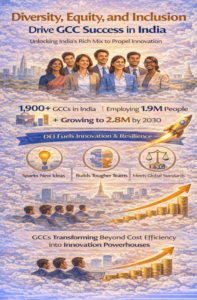
Diversity, Equity, and Inclusion (DEI) play a big role in how Global Capability Centers (GCCs)
grow and succeed around the world, especially in India. Today, India is home to around 1,900
GCCs, employing nearly 1.9 million people, and this number is expected to rise to 2.8 million by
2030. DEI helps these centers tap into India’s rich mix of languages, cultures, and life experiences,
which leads to fresh ideas and stronger, more resilient teams. For business leaders, DEI is no
longer just about doing the right thing it helps meet global standards like ESG requirements and
turns GCCs into innovation hubs, not just low-cost delivery centers

Globally, organizations are rethinking DEI as part of the future-of-work strategy. Remote and
hybrid models have widened talent pools, allowing companies to hire beyond traditional
geographies
DEI helps teams think smarter by bringing together different viewpoints and creating safe
spaces where people can share ideas without fear. This is especially important during major
tech shifts like AI adoption, ethical decision making, and global compliance reporting. Studies
show that inclusive teams can improve innovation outcomes by 15–20%.
When leaders actively include people from all backgrounds, they make better and faster
decisions, reducing blind spots. Organisations with strong inclusion practices see up to 30%
higher employee engagement and 20–25% lower attrition, which directly impacts productivity
and cost savings. For GCCs managing large, diverse teams across time zones, this stability is
critical.
Globally, organizations are rethinking DEI as part of the future-of-work strategy. Remote and
hybrid models have widened talent pools, allowing companies to hire beyond traditional
geographies. Studies show that diverse teams are 25–35% more likely to outperform their
peers in decision making and innovation.
India brings a unique dimension to DEI. The workforce here is young, highly skilled, and rapidly
digitizing. Over 65% of India’s population is under 35, making graduate hiring and early career
inclusion a major focus area for GCCs. Leading centers now invest in structured programs for
women in tech, neurodiverse talent, and professionals returning to work after career breaks. For
example, several Bengaluru based GCCs have increased women representation in mid
management from 20% to over 30% within five years by redesigning career paths and flexible
work policies.
India’s evolving role in global enterprise strategy further amplifies the importance of DEI. Today,
Indian GCCs are not just executing tasks they are leading product development, AI research,
cybersecurity, and platform engineering. This shift requires leaders who can manage diverse,
cross-cultural teams and build psychologically safe environments where ideas flow freely.
DEI in GCCs is about more than representation numbers. It is about building
systems that allow different people to contribute fully and fairly. For HR startups and business
leaders, investing in inclusive design, AI-driven fairness, and future-ready talent strategies is not
just the right thing to do it is smart business. As GCCs continue to grow toward a projected $110
billion industry, DEI will remain a powerful driver of sustainable, global success.