

Over the last decade, GCC trends have clearly changed. Earlier, companies set up GCCs mainly
for IT support or shared services. Now, GCCs handle advanced analytics, product engineering,
cybersecurity, AI models, and even global decision-making. India alone hosts 1,500+ GCCs
employing more than 1.6 million professionals, and this number is expected to grow steadily as
global firms look for stable, skilled talent hubs.

India’s continued focus on digital infrastructure, startup ecosystems, and ease of doing
business makes it a preferred destination for global enterprises. Stable talent supply, competitive
costs, and a strong STEM graduate base give India an edge over emerging alternatives. For global
CEOs, India is no longer just an execution hub it is a strategic innovation partner.
A major driver behind this shift is future-of-work thinking. Work is no longer defined by location,
but by capability. GCCs are being designed as capability centres, not headcount centres. This
means companies are investing in long term talent, internal mobility, and knowledge depth.
Instead of outsourcing expertise, enterprises now want to build it in-house through SMEs who
understand both the business and the technology.
This is where Centres of Excellence (CoEs) come in. A CoE is a focused team that owns a critical
capability such as cloud engineering, AI governance, HR analytics, or automation. For example, a
global bank may run its risk analytics CoE from Bengaluru, supporting teams across the US,
Europe, and Asia. This model improves speed, quality, and accountability.
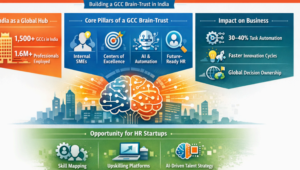
AI and automation are accelerating this transformation. According to industry estimates, up to
30–40% of repetitive enterprise tasks can be automated using RPA and AI tools. This shifts
human roles toward judgment, creativity, and problem-solving. In GCCs, this means fewer
transactional roles and more demand for AI trainers, automation architects, and data
translators. SMEs who can work alongside AI systems are now more valuable than ever.
India’s continued focus on digital infrastructure, startup ecosystems, and ease of doing
business makes it a preferred destination for global enterprises. Stable talent supply, competitive
costs, and a strong STEM graduate base give India an edge over emerging alternatives.
In conclusion, building a GCC brain-trust is not a one-time initiative. It is a long-term talent and
capability strategy. For HR startups, the opportunity lies in enabling this transformation through
smarter hiring, continuous learning, AI enabled workforce tools, and future-ready HR models. The
GCCs that invest today in people, knowledge, and innovation will define how global work gets
done tomorrow.