

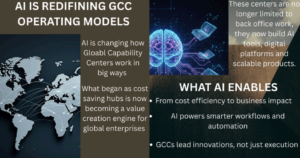
AI is changing the way Global Capability Centers (GCCs) work. Earlier, many of India’s 1,900
GCCs, employing around 1.9 million people, mainly focused on cutting costs and handling routine
work. Today, that story is different. With AI, these teams are building smart tools, digital platforms,
and real products that help businesses grow and innovate.

AI is taking over routine and repetitive tasks, so teams can focus on more meaningful work like
product design, research, and data driven insights.They are building AI solutions in India
that directly help their global headquarters grow sales and improve decisions. For example,
companies like UKG and Sonoco use their India-based teams to develop analytics platforms and
digital tools that influence results across markets worldwide.
AI driven hiring helps GCCs find capable talent faster and reduce mismatches. One large BFSI
GCC in Bengaluru used AI based assessments and reduced its hiring cycle time by nearly 30%,
while improving early performance scores
One of the biggest changes AI brings is how work itself is designed. Traditional GCC models were
built around fixed roles and predictable processes. Today, AI enables dynamic operating
models, where work is broken into skills, projects, and outcomes rather than job titles. For
example, instead of hiring a “software engineer,” GCCs now build teams around capabilities like
cloud automation, data engineering, or AI model tuning.
Beyond hiring, AI plays a strong role in learning and workforce development. Modern GCCs are
building internal learning ecosystems powered by AI that recommend courses, projects, and
mentors based on an employee’s role and career goals.This approach not only improves productivity but also
boosts retention. Studies show that employees who see clear growth paths are 2× more likely to
stay with their organization
AI tools track outcomes, collaboration, and skill
usage rather than hours spent at work. This reduces bias and helps managers focus on coaching
rather than judging. Many GCCs report 20–30% higher engagement scores after moving to
continuous feedback models supported by analytics.
GCCs are no longer just cost
centers; they are core contributors to global strategy. Many multinational firms now run AI
product development, automation platforms, and enterprise analytics entirely from India-based
GCCs. This reflects a larger trend where AI allows distributed teams to operate with the same
speed and quality as headquarters teams.
In short, AI is not just improving GCC efficiency it is redefining how GCCs operate, grow, and
compete globally. The winners will be those who combine technology with thoughtful people
strategies, ensuring that innovation and employee experience grow together.