

Artificial intelligence is moving fast across Global Capability Centers (GCCs). From automating
finance workflows to deploying predictive analytics in supply chains, AI + automation are
becoming central to enterprise strategy. India alone hosts 1,900+ GCCs employing over 2
million professionals, and a growing share of them are leading global AI programs. But before
deploying advanced AI systems, there is one critical foundation that cannot be ignored: AI
governance
GCC trends clearly show a shift from cost-focused operations to value-driven innovation
hubs. Many centers now manage global data platforms, AI research labs, and automation
programs. Studies indicate that 30–40% of enterprise tasks can be automated using current
technologies, delivering 20–30% productivity gains and 15–25% cost savings
Governance is not just a
technology function; it is a people strategy. HR teams must design clear AI usage policies,
define ethical standards, and embed compliance training across the workforce. If 60–70% of
employees are expected to use AI tools in their daily tasks, AI literacy and responsible usage
training must become mandatory. HR startups have a strong opportunity here.
Employees must understand how AI tools make recommendations, what data they use, and
where human oversight is required. If governance frameworks are weak, trust inside the
organization erodes. Strong governance ensures that AI remains a co-pilot rather than an
uncontrollable decision-maker.
India’s expanding digital economy, projected to reach $1 trillion by 2030, is supported by
increasing attention to data governance and digital compliance. For multinational
corporations operating GCCs in India, aligning with both global and local regulatory
frameworks is critical. Governance models must anticipate future regulations rather than
react to them.
India’s evolving role in global enterprise strategy makes governance even more important.
Many multinational companies now assign end-to-end AI product ownership to their Indian
GCCs. This means models developed in India may influence global customers across regions.
Decision-making authority is shifting, and with it comes responsibility.
AI + automation initiatives often begin with excitement around efficiency gains. But
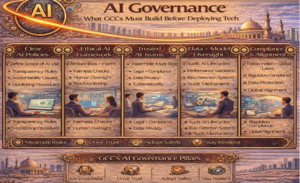
sustainable transformation depends on trust. Governance frameworks should include clear
data usage policies, bias monitoring systems, human-in-the-loop controls, audit mechanisms,
and measurable accountability standards. Enterprises that embed governance at the design
stage rather than as an afterthought will scale faster and safer.
AI governance is not a compliance checkbox; it is a strategic investment. As GCCs automate
up to 40% of repetitive work and lead enterprise AI programs, building governance
capabilities becomes a competitive differentiator. Organizations that act early will protect
brand value, attract responsible clients, and build long-term resilience.
In simple terms, before deploying advanced AI technology, GCCs must build trust
infrastructure. Strong governance aligns innovation with ethics, productivity with
compliance, and growth with responsibility. India’s GCC ecosystem is powerful and growing.
The next phase of leadership will belong to those who innovate boldly but govern wisely.