

One of the most common mistakes global enterprises make when setting up a GCC in India is treating
it like a generic talent centre. They define roles broadly, hire for general skills, and then wonder why the
centre struggles to deliver the strategic value they expected. The answer almost always comes back
to the same root cause — the absence of a capability map. A capability map is not just a list of job titles
or a skills inventory.
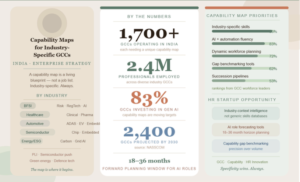
India’s GCC landscape has grown to over 1,700 centres employing 2.4 million professionals, and
the diversity of industries now represented within that number is striking. Banking and financial
services GCCs need capability maps that are fundamentally different from those built for healthcare or
automotive companies. A BFSI GCC needs deep expertise in risk modelling, regulatory technology,
anti-money laundering systems, and AI-driven credit analytics.

Over 83% of India-based GCCs are currently investing in Generative AI, which means the capability
gaps they are trying to close are moving targets. A capability map built today needs to account not just
for the skills required now but for the skills that will become critical in the next 18 to 36 months as AI
tools mature and get embedded into core business processes. This requires a fundamentally different
approach to workforce planning — one that is dynamic, data-driven, and updated continuously rather
than reviewed annually.
The market is hungry for tools that can help GCC leaders build industry-specific capability
frameworks, benchmark their current workforce against those frameworks, identify gaps with
precision, and generate targeted learning and hiring recommendations. Generic skills databases are
not sufficient for this purpose. What GCC leaders need is industry-contextual intelligence — tools
that understand the difference between what a semiconductor GCC needs from a data engineer and
what a retail GCC needs from the same profile. The companies building that level of specificity into
their HR products are the ones that will win serious enterprise contracts over the next five years.
 .
.
GCCs in sectors like cleanenergy, chip design, and defence technology are building their capability maps almost from scratch,
which means there is no established talent pipeline to draw from. This creates both a challenge and an
opportunity — a challenge for HR teams trying to hire for roles that the market has not yet produced at
scale, and an opportunity for training organisations and HR tech platforms that can help bridge the
gap.
When a global company decides to place a critical function inside its India GCC, it is
making a statement about where it believes the best capability can be built and sustained. Getting
that capability map right determines whether the GCC becomes a true strategic asset or an expensive
experiment. With 2,400 GCCs projected by 2030, the organisations that invest in building precise,
industry-specific capability frameworks today will be the ones leading their sectors tomorrow.