

Something significant is happening across India’s major cities, and it is bigger than just another wave
of hiring. Capability clusters — concentrated zones of deep, specialised talent — are emerging at a
pace that is reshaping how global enterprises think about their growth strategies. For HR leaders and
workforce planners, this is not a trend to monitor from a distance. It is a structural shift that demands
immediate strategic attention.
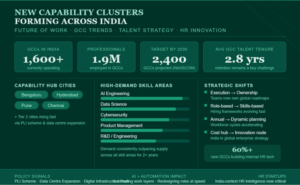
India already houses over 1,900 Global Capability Centres (GCCs), employing close to 1.9 million
professionals, and that number is expected to climb to 2,400 GCCs by 2030 according to NASSCOM.
These are no longer back-office support functions. Teams in Bengaluru, Hyderabad, Pune, and
Chennai are now owning product roadmaps, leading AI research, running enterprise-wide analytics, and
making decisions that affect global operations directly.

The capability clusters forming today are domain-specific and deeply skilled. Financial services firms
are building risk modelling and regulatory compliance centres. Technology companies are placing their
AI and machine learning cores in India. Engineering-led enterprises are setting up R&D hubs that
report directly into global leadership. This shift from execution to ownership is the defining story of
India’s evolving role in global enterprise strategy.
What is enabling this at scale is a combination of policy momentum and economic logic. India’s
government has pushed initiatives around digital infrastructure, semiconductor investment, and skilling
programmes that are creating an environment where high-complexity work can thrive. The Production
Linked Incentive (PLI) scheme and the expansion of data centre capacity across Tier 1 and Tier 2
cities are quietly building the foundation for the next generation of enterprise capability hubs.
For HR and talent strategy leaders, particularly those working within or building for GCC environments,
the implications are profound. The talent market is tightening in key capability areas. Roles in AI
engineering, data science, cybersecurity, and product management have seen demand outpace
supply consistently over the last two years. Attrition in high-skill segments remains a live challenge,
with average tenure in GCC roles sitting at roughly 2.8 years.
AI and automation are simultaneously creating new pressures and new opportunities within this
landscape. Enterprises are not automating jobs wholesale; they are automating layers of work, which
means roles are being redesigned faster than traditional HR systems can keep up with.Organisations investing in
skills-based hiring frameworks and continuous learning infrastructure are pulling ahead, while those
still anchored to role-based hiring models are finding themselves perpetually behind the curve.
The capability clusters forming today will
define the talent landscape for the next decade. For HR professionals and workforce strategists, the
question is no longer whether to engage seriously with this shift. The question is how quickly you can
build the frameworks, the tools, and the insight to move with it.