

The financial services industry is being reshaped by rapid digital innovation, and FinTech-led
disruption is at the center of this change. Global Capability Centers (GCCs) in India are playing a
major role in enabling this transformation by supporting global banks, payment companies, and
FinTech firms with advanced technology, analytics, and product development. India has become a
strategic hub for these centers, with 1,900+ GCCs employing over 2 million professionals.
One of the most important GCC trends in the FinTech space is the shift from traditional banking
support to innovation-led, platform-driven models. Earlier, GCCs mainly handled transaction
processing, customer service, and basic IT functions. Today, they are deeply involved in building
digital payment platforms, blockchain-based solutions, open banking systems, and real-time
financial analytics.

The role of AI + automation in FinTech GCCs is transformative. Technologies such as artificial
intelligence, machine learning, and robotic process automation are helping financial institutions
improve efficiency, reduce risks, and enhance customer experience. AI is widely used in fraud
detection, credit scoring, personalized banking, and algorithmic trading. Studies suggest that 40–
50% of financial operations can be automated, leading to 25–30% cost savings and efficiency
improvements.
FinTech GCCs are using AI-powered recruitment tools to identify candidates with specialized skills
in data science, cybersecurity, and digital finance. Digital learning platforms are helping employees
upskill in areas such as blockchain, cloud computing, and financial analytics. HR teams are also
focusing on improving employee experience, flexible work models, and building strong employer
brands around innovation and growth.
As automation takes over repetitive tasks, professionals are expected to focus more on analytics,
product innovation, and strategic decision-making. New roles such as data scientists, blockchain
developers, risk analysts, and FinTech product managers are becoming highly востребованы. For
graduates, this creates exciting opportunities, but it also requires continuous learning in areas like
data analytics, financial technologies, and regulatory frameworks.
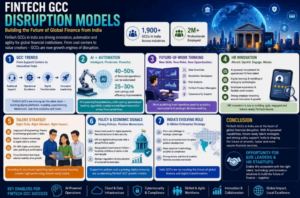
The rapid adoption of UPI and digital banking solutions has positioned India as a global leader in
FinTech innovation. Globally, the FinTech market is expected to grow significantly, with investments
reaching hundreds of billions of dollars over the next decade. Increasing regulations around data
privacy and financial security are also pushing companies to adopt advanced technologies and
compliance systems.
Many multinational banks and FinTech companies are setting up or expanding their GCCs in cities
like Bengaluru, Hyderabad, Mumbai, and Pune. These centers are no longer just support units; they
are becoming innovation hubs that drive global product development and digital transformation.
From building secure payment platforms to managing real-time analytics systems, India-based
GCCs are contributing directly to the future of global finance.
In conclusion, FinTech GCC disruption models highlight a broader shift toward technology-driven
financial services. With strong AI-powered capabilities, evolving talent strategies, and supportive
policy frameworks, GCCs in India are becoming central to global financial innovation.
As financial services continue to evolve, India’s GCCs will remain at the
forefront of building faster, smarter, and more secure financial systems worldwide.