

The aviation industry is undergoing a strong transformation, and Global Capability Centers (GCCs)
in India are becoming an important part of this evolution. As airlines, aircraft manufacturers, and
aviation service providers focus on improving efficiency, safety, and customer experience, the
demand for digital capabilities and skilled talent is rising.
One of the key GCC trends in aviation is the shift from traditional support roles to high-value,
innovation-driven functions. Earlier, aviation GCCs mainly handled ticketing support, customer
service, and back-office operations. Today, they are involved in advanced areas such as aircraft
design support, predictive maintenance, flight operations analytics, digital twin technology, and
airline revenue management systems.

The role of AI + automation in aviation GCCs is growing rapidly. Technologies like machine learning,
predictive analytics, and robotic process automation are helping companies optimize flight
operations, improve fuel efficiency, and enhance safety. Automation is also streamlining airport
operations and back-end processes. Studies suggest that 30–40% of aviation-related processes
can be automated, leading to 20–25% improvement in operational efficiency.
As automation
reduces the need for repetitive tasks, employees are expected to focus more on analytics,
engineering innovation, and strategic planning. New roles such as aviation data analysts, flight
operations specialists, aerospace software engineers, and AI modelers are becoming more
important. For graduates, this creates exciting opportunities, especially for those interested in
combining engineering, data, and technology within the aviation sector.
Aviation GCCs are using AIpowered recruitment tools to identify candidates with specialized skills in aerospace engineering,
data analytics, and digital technologies. Digital learning platforms are helping employees upskill in
areas like aviation analytics, safety systems, and automation tools. HR teams are also focusing on
improving employee engagement, offering flexible work models, and building strong employer
brands that highlight innovation and global exposure.
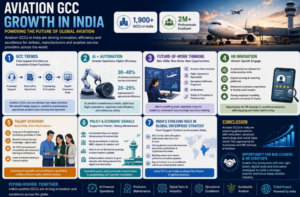
Many global aviation companies are setting up or expanding their GCCs in cities like Bengaluru,
Hyderabad, Chennai, and Pune. These centers are no longer limited to support functions; they are
becoming innovation hubs that contribute to global product development, operations optimization,
and digital transformation. From improving flight safety systems to developing advanced analytics
platforms, India-based GCCs are playing a key role in shaping the future of aviation.
In conclusion, aviation GCC growth in India reflects a broader shift toward technology-driven and
innovation-led operations. With strong AI-powered capabilities, evolving talent strategies, and
supportive policy frameworks, these centers are becoming strategic assets for global aviation
companies. As the aviation industry continues to grow
and modernize, India’s GCCs will play a crucial role in building a more efficient, safe, and connected
global aviation network