
Current GCC trends clearly show a shift toward high-value, knowledge-driven work. Nearly
60–70% of new GCC setups are focused on digital, data, and AI capabilities rather than
traditional back-office operations. This shift demands a workforce that understands not just
how to use AI tools, but how AI impacts business models, customer experience, and
operational efficiency. AI literacy is not limited to engineers or data scientists. Finance teams
use automation tools, HR teams deploy AI in hiring, and operations teams rely on predictive
analytics.
Employees must move from repetitive execution to problem-solving, decision-making, and
innovation. Organizations that prepare their workforce for this shift can unlock 20–25%
productivity improvement while enhancing employee satisfaction. AI literacy helps
individuals adapt confidently rather than fear displacement.
AI technologies evolve rapidly, and so must skill-building
strategies. HR teams in leading GCCs are using AI-driven skill assessment platforms to map
capability gaps in real time.
presents a major opportunity to design agile, tech-enabled learning and hiring solutions that
match the pace of enterprise change.
. India produces over 1.5 million
graduates annually, yet companies often report a shortage of industry-ready AI talent. The
solution is not just external hiring but structured internal upskilling. Organizations that invest
in continuous learning reduce hiring costs and build long-term loyalty. Forward-looking GCCs
are creating AI centers of excellence, cross-functional innovation labs, and partnerships with
universities and edtech platforms.
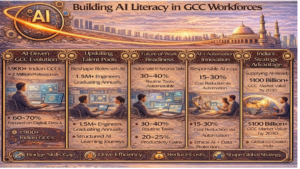
AI and automation are also transforming cost structures and operating models. Intelligent
automation can reduce operational expenses by 15–30% while improving accuracy and
turnaround times. In HR, AI tools screen thousands of resumes in minutes. In finance,
automation reduces reconciliation errors. In customer operations, AI chatbots improve
response speed and consistency
GCCs are no longer seen as support centers; they are strategic innovation
partners contributing to product development and global decision-making. Building AI
literacy is therefore not just a training initiative. It is a long-term investment in
competitiveness, resilience, and global relevance.
For B2B leaders and HR startups, the message is clear. Organizations that embed AI literacy
across functions will lead the next phase of GCC growth. The future belongs to enterprises
that combine human intelligence with machine capability, creating workplaces that are
efficient, adaptable, and innovation-driven.