
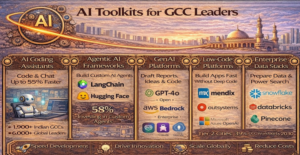
Tools like GitHub Copilot help developers write code faster and even assist with
documentation and communication. Many teams report productivity improvements of up to
55% when using AI coding and collaboration assistants. This means faster product releases
and better efficiency across global teams.
Around 58% of organizations are now investing in what is called agentic AI -AI systems that
can act independently to complete tasks. Frameworks like LangChain allow teams to build
custom AI agents that can search, analyze, and respond based on company data.
Generative AI platforms are also transforming everyday work. Models such as GPT-4o and
Claude can draft reports, generate ideas, summarize documents, and even write code. For
enterprise-grade security and compliance, cloud platforms like AWS Bedrock and Azure
OpenAI Service provide controlled environments with governance features.
Low-code platforms are another important toolkit for GCCs. Tools like Mendix and
OutSystems allow teams to build business applications quickly without writing complex code.
This empowers business users and reduces development time, making digital transformation
faster and more inclusive.
Behind all AI applications lies strong data infrastructure. Platforms such as Snowflake and
Databricks help organizations prepare, clean, and manage data for AI use. For advanced AI
search and intelligent agents, vector databases like Pinecone enable fast similarity search
and contextual understanding, which power smarter AI-driven applications.
Recruitment platforms now use
AI to screen resumes, assess skills, and reduce hiring bias. These tools can cut hiring cycles
by 30–40% while improving match quality. AI-driven chatbots handle employee queries
around the clock, reducing administrative workload by up to 50%.
AI and automation toolkits also improve operational efficiency. Intelligent automation
platforms streamline repetitive processes in finance, HR, and operations. When automation
handles routine tasks, human talent can focus on innovation, customer experience, and
strategic decision-making. Companies that effectively combine AI with automation report
cost efficiencies of up to 25%, making scale both sustainable and profitable.
In simple terms, these AI toolkits help GCC leaders move faster, innovate smarter, and scale
globally. For graduates, learning how these tools work can open exciting career opportunities
in AI, data, and digital transformation. For B2B decision-makers, investing in the right mix of
AI platforms, data systems, and automation tools ensures long-term competitiveness in
India’s rapidly expanding GCC landscape