

As Global Capability Centers (GCCs) adopt AI at scale, a new conversation is becoming critical:
ethics. While automation improves speed and efficiency, how AI is deployed matters just as
much as why it is deployed. Ethical AI is no longer a technical detail. It is a business priority

AI systems process sensitive data, influence hiring
decisions, detect fraud, and even support customer communication. If not governed carefully,
they can create bias, security risks, or compliance failures.
Another big concern is data leaks and privacy risks. AI systems often process large volumes of
sensitive information, including employee records, customer details, and financial data. If
security systems are weak, this data can be exposed. For GCCs that handle global operations,
even a small breach can damage trust and lead to regulatory penalties.
. As multinational
companies assign more ownership of AI systems and data strategy to their India-based GCCs,
governance becomes a competitive advantage. Ethical AI is not just about avoiding risk it
builds credibility and long-term global partnerships.
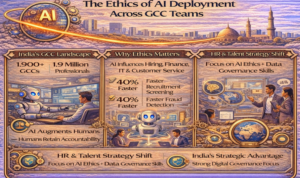
India is taking active steps to address these risks. The government launched the IndiaAI Mission
with an allocation of ₹10,300 crore to promote responsible and safe AI development. This
investment supports research, infrastructure, and frameworks that encourage ethical AI
practices. A strong focus of this mission is building safeguards such as audits, transparency
standards, and human oversight mechanisms.
In response, many GCCs are strengthening their governance structures.
officers, and HR professionals. These teams regularly test AI models for fairness, accuracy, and
security. They also define clear internal policies about how AI tools can and cannot be used.
Overall, the message is simple: AI can bring speed and efficiency, but it must be deployed
carefully. Strong governance, human oversight, and policy support like the ₹10,300 crore
IndiaAI Mission are essential to building trust in AI systems. GCCs that prioritise ethical
deployment today will be better prepared for sustainable growth tomorrow.