
Global Capability Centers, or GCCs, are going through a major shift. For years, they were
known mainly for cost savings and back-office support. Today, that image is changing fast. AI
native GCCs are built with artificial intelligence at their core, not added later as a tool. This
shift is helping GCCs move from doing routine work to driving real innovation for global
companies.
Mid-sized and even small, focused GCCs are driving a big shift in how work gets done. Instead
of building huge teams to handle routine tasks, they are creating specialized, high-skill roles
that focus on areas like AI research, data science, and advanced engineering. .
Even large companies are moving in this direction. Fortune 500 GCCs now employ over
126,600 professionals in AI-related roles, and they contribute to 22.5% of India’s total AI
talent demand. That’s a strong signal that AI is no longer a side project it’s becoming core to
how global businesses operate from India.
Another key factor supporting this shift is flexibility. Around 95% of GCCs follow hybrid work
models, allowing teams to collaborate across cities and countries while still attracting top
talent. This flexible setup makes it easier to hire niche experts and build focused, innovationdriven teams
Generative AI tools now
help write code, test software, analyze data, and even create content. For example, global
firms like UKG and Sonoco use their India GCCs to build analytics platforms that support
worldwide operations.
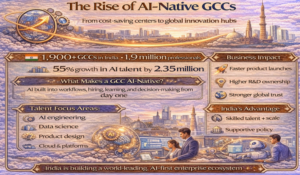
India’s role in global enterprise strategy is also evolving. GCCs are no longer just execution
arms. They are becoming co-creators of global products and platforms. AI-native GCCs help
parent companies launch faster, test ideas quicker, and adapt to market changes with speed.
This gives businesses a strong competitive edge in uncertain times.
From an HR innovation point of view, AI-native GCCs need a very different talent strategy.
Companies are no longer hiring only based on degrees or past job titles. They are hiring for
skills in AI engineering, data science, cloud platforms, and product thinking. By 2026, India’s
AI talent pool is expected to grow by 55%, reaching around 2.35 million professionals.
For HR startups and B2B leaders, the message is clear. The future belongs to organizations
that build AI-first talent models, continuous learning ecosystems, and human-centered
leadership. AI-native GCCs are not just a technology shift they are a new way of working. And
India is leading that future.