

Global Capability Centers (GCCs) in India are no longer judged by how many people they hire,
but by what those people can actually deliver. Today, India has 1,900+ GCCs employing
nearly 2 million professionals, and B2B leaders are rethinking skills in a big way. The old
approach of hiring for fixed job titles is slowly fading. Instead, companies are focusing on
what skills employees have, how fast they can learn, and how quickly they can create
business value. This change is driven by real pressure—only 8–10% of GCCs are considered
truly mature, while skill gaps in areas like AI, cloud, and cybersecurity affect 41–53% of roles.
As a result, a new skills matrix is taking shape, where adaptability, continuous learning, and
impact matter more than headcount. This shift reflects a major GCC trend: value now
matters more than volume.

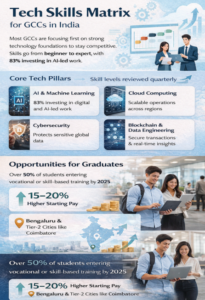
Many GCCs are also adding blockchain for secure transactions and data engineering to turn raw data into
real-time insights. High-performing centers don’t treat skills as static—they track skill levels
from beginner to expert and review them every quarter as technology keeps changing. For
graduates, this creates real opportunity. With over 50% of students entering vocational or
skill-based training by 2025, many step straight into GCC roles and earn 15–20% higher
starting pay, especially in hubs like Bengaluru and growing tier-2 cities such as Coimbatore.
This infographic breaks down the core tech skills GCCs are building today and why AI, cloud,
and cybersecurity matter more than ever for future-ready teams
Talent strategy is what brings everything together. Instead of always hiring from the outside,
many GCCs now focus on growing their own people. They invest in internal upskilling, role
rotations, and clear career paths, which helps reduce attrition rates stuck at 13–15% across
the market. Companies that follow this approach see more stable teams and stronger
performance, even when the market is uncertain. In fact, over 70% of leading GCCs now
prioritize internal mobility to protect critical skills.
Soft skills form the other half of the skills matrix, and they matter just as much as technical
knowledge. Skills like problem-solving, cross-cultural teamwork, and fast learning help global
teams work smoothly across countries and time zones. Leading GCCs now connect these
skills directly to real business results, such as faster project delivery, higher innovation
output, and smoother decision-making. Instead of long classroom sessions, upskilling
programs focus on hands-on projects and real prototypes, which has proven to improve
retention even when industry attrition sits at 13–15%.
A strong skills matrix helps GCCs grow smoothly without confusion or lastminute firefighting. It keeps teams aligned, avoids 20–30% cost overruns, and helps companies get real value as the GCC market heads toward $100 billion by 2030. When skills
are managed like valuable assets and not just checkboxes, GCCs move beyond being low-cost.