

 Global companies today are learning a tough lesson: the world is unpredictable. Shipments get stuck, factories shut down suddenly, political tensions rise, and sometimes even a single delay can cost a company millions. To avoid these shocks, firms are now building GCCs in India as Global Risk Centers. These centres don’t just support business—they protect it. They monitor risks, predict disruptions, and help companies stay stable even when everything else feels shaky. One big reason this shift is happening is because **India has the largest GCC workforce in the world—over 1.7 million skilled professionals, and this number is expected to reach 2.5 million by 2030. With so many people trained in analytics, engineering, cybersecurity, AI, finance, and supply chain, companies feel confident giving India their most sensitive, mission-critical work. This makes India a “safety net” in global operations. Companies now trust India with real-time risk monitoring. Instead of waiting for something to go wrong, Indian GCCs use data tools and dashboards to catch signals early. A delay in a port? A shortage of raw materials? Sudden price spikes? Policy changes? The India team alerts global leaders before the disruption actually hits. This shift—from reacting to predicting—is a massive global advantage. A good example is Walmart’s India GCC, where the analytics team created a supply-chain visibility model. This helped Walmart reduce delivery errors by 22% across the U.S. The improvement saved around USD 14 million per year. What makes this impressive is that the project cost only a fraction of what it would have cost in the U.S. The important point is that India is not just saving money—India is saving companies from risk.It’s not only logistics companies. Even banks depend on India. A large European bank moved its risk modelling function to India. The team in Bengaluru spotted credit-risk exposures 30%faster, helping the bank avoid loan losses worth USD 40 million. The cost of running this entire team in India was less than one-third of the cost in Europe. This showed that GCCs aren’t cost centers anymore—they are risk-protection engines.
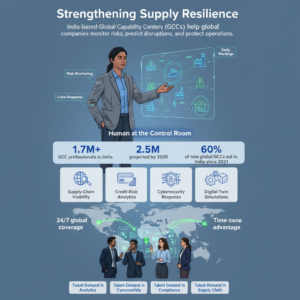 Another big strength is 24/7 operations. Because India operates ahead of the U.S. and Europe, GCCs can run continuous monitoring. If a crisis hits at 2 AM in London, the team in India is awake and handling it. This time-zone advantage alone has helped some companies avoid major system shutdowns. During a cyberattack in 2023, an India-based team at a Fortune 100 tech company restored systems 4 hours faster than the U.S. office. Those four hours saved nearly USD 3 million in downtime losses. Technology also makes Indian GCCs powerful. Most centers use AI, automation, cloud, and digital twin simulations to map supply chains. These tools help companies visualise where risks might occur before they happen. For example, an automotive firm’s GCC in Chennai built a simulation model that predicted semiconductor shortages six weeks early, allowing the company to adjust suppliers and save almost USD 25 million in potential production loss. That early alert came entirely from India. India’s government has supported GCC expansion through policies like special economic zones, digital regulations, and easier operational compliance. Because of this, India became the preferred destination for over 60% of all new GCCs set up globally since 2021. This means companies feel safe putting their most important work in India. For HR companies, all of this creates massive opportunities. The boom in risk-focused GCC roles—planning, analytics, cybersecurity, compliance, supply chain modelling—means HR firms can place thousands of candidates in high-value, future-proof jobs. Companies also need help building skills in AI, automation, and crisis management. So HR firms that train people in these areas can grow incredibly fast. Simply put, GCCs create demand for skilled talent, and HR firms become the bridge that supplies this talent. In simple terms, India’s GCCs have become the “control room” of global companies. They watch over operations, warn leaders before trouble hits, and build strong recovery plans. Whether it’s a supply shortage, a shipping delay, a price shock, or a cyber threat, the India GCC steps in first and saves the company from losses. This is why global firms are no longer saying “let’s outsource to India.” They are now saying, “let’s put our most important functions in India.”