

For decades, employee performance management relied on linear, effort-based metrics: hours logged,
lines of code written, tickets resolved, and reports filed. In a manual work environment, volume was a
reliable proxy for productivity. However, as artificial intelligence transitions from a basic drafting tool to
core operational infrastructure, traditional performance appraisals have broken down. In an enterprise
setting where autonomous AI agents write baseline code, draft legal documentation, and analyze
financial models in seconds, evaluating employees on raw output volume is no longer relevant. In 2026,
Global Capability Centers (GCCs) and product organizations face a critical performance question:
Should employees be measured on AI-augmented productivity, and if so, how do we evaluate
human judgment over machine speed?
This dilemma is reshaping macro GCC trends across India’s technology ecosystem.The nation’s
capability landscape encompasses 2,117 active GCCs employing over 2.36 million professionals
within a $98.4 billion economic sector. Crucially, with 59% of GCCs prioritizing AI-first value
creation and over 90% of centers owning global product roadmaps, evaluating performance
based on outdated speed metrics creates dangerous operational incentives. If an engineer uses
generative tools to push 300% more lines of code without auditing for security vulnerabilities or
architectural debt, traditional productivity charts register high performance, but the enterprise incurs
severe technical liability.
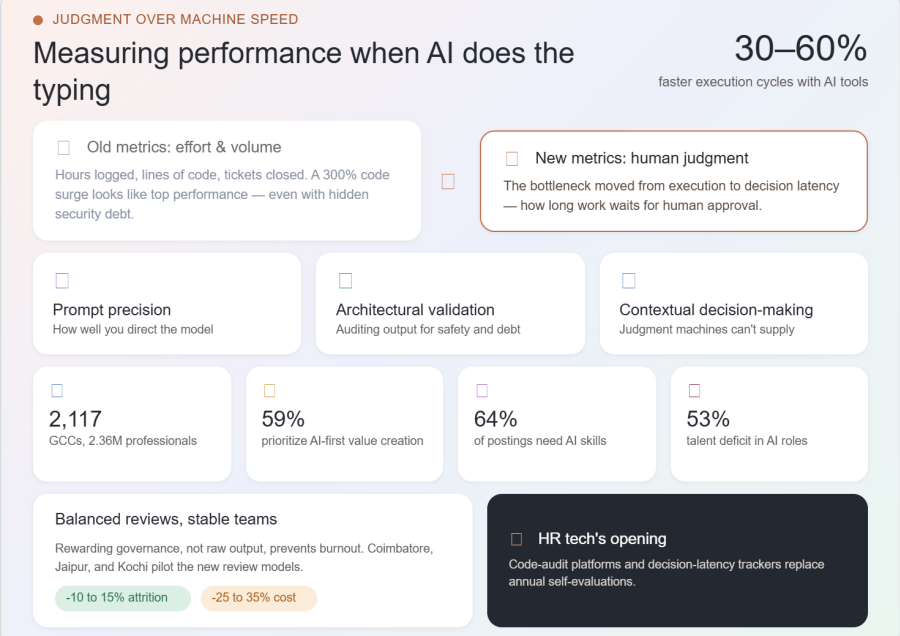
The underlying technical catalyst is the rapid integration of AI and automation into daily workflows. As
intelligent tools compress standard execution cycles by 30% to 60%, the primary bottleneck shifts
from task execution to decision latency—the time work spends waiting for human evaluation
and approval.With 64% of all new GCC job postings requiring advanced AI capabilities
alongside an industry-wide 53% talent deficit in specialized AI roles, enterprise evaluations must
pivot. Instead of measuring how fast an employee generates a draft, forward-thinking organizations
evaluate three core AI-augmented competencies: prompt precision, architectural validation, and
contextual decision-making.
Re-architecting appraisal frameworks requires progressive future-of-work thinking that transforms
enterprise talent strategy. Measuring AI-augmented productivity without rewarding governance
creates burnout and encourages low-quality automated output.To build balanced performance
systems without suffering extreme talent churn in primary metros like Bengaluru and Hyderabad, global
firms are deploying updated review models across regional hubs like Coimbatore, Jaipur, and Kochi.
Establishing specialized evaluation frameworks in secondary centers enables GCCs to achieve 10% to
15% lower voluntary attrition rates while securing 25% to 35% in overall operational cost
savings, creating stable environments where employees focus on high-impact problem-solving rather
than artificial activity metrics.
This performance overhaul creates an extraordinary growth vector for HR innovation, driving rapid
market adoption for agile B2B HR startups. Legacy appraisal software built for annual self-evaluations
and manager ratings cannot assess human-AI collaboration dynamics. High-growth HR tech startups
developing real-time code audit platforms, decision-latency tracking engines, AI contribution analytics,
and judgment-based appraisal tools are seeing rapid enterprise integration. Modern performance