

As India’s Global Capability Centers (GCCs) transition from operational delivery arms into
strategic business command centers, they are running into a new organizational reality:
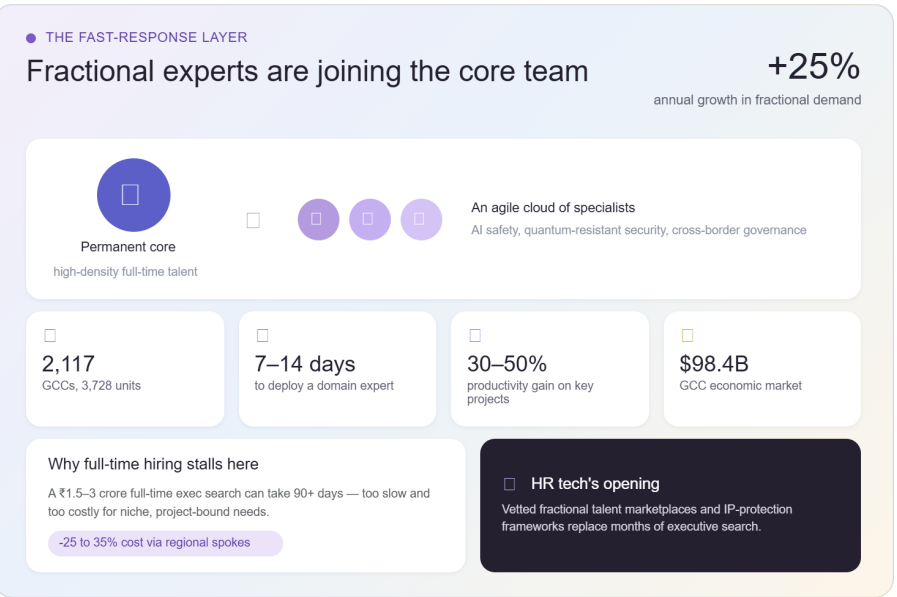
the traditional, full-time employment model is struggling to keep pace with hyperspecialized technical needs. When a center needs an expert to audit an autonomous AI
safety framework, design a quantum-resistant security protocol, or navigate complex
cross-border AI governance, hiring a full-time executive at an annual compensation of
₹1.5 crore to ₹3 crore—a process that often takes over 90 days—is no longer financially or
operationally viable. To bridge this gap, forward-thinking GCCs are turning to fractional
talent—on-demand, high-impact experts brought in for specific strategic outcomes.
This shift toward fractional expertise is transforming macro GCC trends across India. The
ecosystem currently encompasses 2,117 active GCCs operating across 3,728 distinct
units, representing a $98.4 billion economic market employing over 2.36 million
professionals. Historically, GCCs scaled by expanding full-time headcount. However, with
over 90% of centers now operating as multi-functional innovation hubs and midmarket GCCs facing severe executive talent bottlenecks, the demand for fractional CXOs,
part-time AI architects, and domain-specific advisors has grown by over 25% annually.
Fractional hiring allows GCCs to access world-class domain knowledge without taking on
long-term fixed balance-sheet liabilities
The primary catalyst accelerating the fractional model is the rapid integration of AI and
automation across business infrastructure. As intelligent software handles routine
operational tasks, the enterprise value shifts toward specialized problem-solving. With
64% of all new GCC job openings mandating advanced AI or machine learning
capabilities against a 53% talent deficit in specialized AI roles, finding full-time experts in
emerging fields like MLOps, agentic workflow architecture, and zero-trust security is
exceptionally difficult. Fractional engagements allow GCCs to plug these specialized
capability gaps immediately, achieving 30% to 50% productivity gains on high-stakes
projects while their internal teams focus on core execution.
Integrating on-demand expertise requires progressive future-of-work thinking to
reshape enterprise talent strategy. Organizations are moving away from treating
workforce planning as a binary choice between full-time employees and external thirdparty vendors. Instead, leading GCCs are building dynamic, blended talent models—
combining a permanent core of high-density talent with an agile cloud of fractional
domain specialists. To manage these hybrid structures efficiently, GCCs are expanding
into regional spokes like Coimbatore, Jaipur, and Kochi, securing 25% to 35% in
operational cost savings while utilizing fractional advisors to establish governance,
compliance, and technical blueprints.
This rise of on-demand expertise presents an extraordinary growth vector for HR
innovation, accelerating market adoption for agile B2B HR startups. Legacy recruitment
agencies and traditional job boards are not structured to evaluate or contract fractional
executives. High-growth HR tech startups developing vetted fractional talent
marketplaces, automated compliance and IP-protection frameworks, real-time milestone
tracking engines, and skill-graph matching platforms are seeing rapid enterprise
integration. Modern platforms allow talent leaders to deploy niche domain experts in 7 to
14 days, replacing months of slow executive search with immediate capability injection.