

As artificial intelligence reshapes global corporate architecture, a profound question is confronting
enterprise boardrooms from Silicon Valley to London: can India’s Global Capability Centers (GCCs)
evolve from execution powerhouses into the primary AI innovation engine for the world? For university
graduates entering the workforce, B2B technology founders, and HR leaders, the answer is no longer a
theoretical debate. Driven by unprecedented technical maturity, strategic ownership, and dynamic
talent density, Indian GCCs are actively laying the groundwork to design, govern, and scale the future
of global enterprise AI.
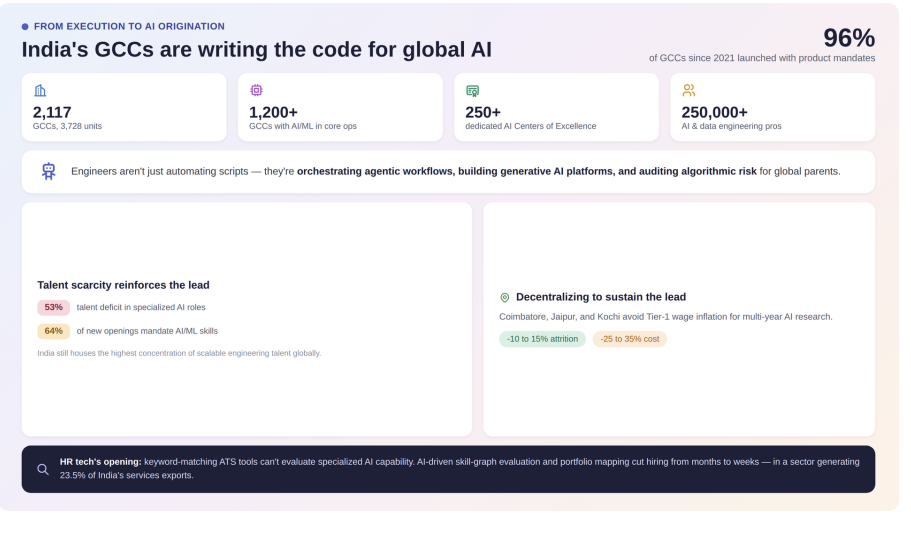
The foundation for this ambition is already built on extraordinary scale. India currently hosts 2,117
active GCCs operating across 3,728 distinct units, representing a $98.4 billion economic market
that employs over 2.36 million skilled professionals. Crucially, the nature of these centers has
undergone a complete transformation.Today, over 1,200 capability centers in India actively embed
AI and machine learning into their core operational frameworks, supported by more than 250
dedicated AI Centers of Excellence and a specialized talent pool of over 250,000 AI and data
engineering professionals. Rather than acting as secondary support nodes, nearly 96% of GCCs
established since 2021 launched with direct product and portfolio mandates, positioning Indian
teams at the very center of global enterprise IP creation.
Indian GCC engineering teams are no longer just building basic
automation scripts; they are orchestrating autonomous agentic workflows, building enterprise
generative AI platforms, managing complex cloud data pipelines, and auditing algorithmic risk models
for global parent organizations.With 64% of all new GCC job openings explicitly mandating
advanced AI or machine learning capabilities, the demand for specialized talent remains intense,
creating an industry-wide 53% talent deficit in specialized AI roles and keeping voluntary tech
churn between 18% and 25%.

Unlocking the full potential of this AI landscape requires progressive future-of-work thinking to
reshape enterprise talent strategy. Global organizations recognize that relying strictly on hypercompetitive Tier-1 hubs causes severe talent friction and wage inflation.To build stable, long-term AI
innovation labs, enterprises are aggressively decentralizing operations into emerging secondary
technology hubs like Coimbatore, Jaipur, and Kochi. Establishing specialized engineering spokes in
these regional centers enables GCCs to realize 25% to 35% in overall operational cost savings
and secure 10% to 15% lower attrition rates, creating stable, high-output environments where crossfunctional engineering teams can focus on multi-year AI research and platform design.
This imperative for continuous capability building creates an extraordinary growth vector for HR
innovation, driving rapid enterprise adoption for agile B2B HR startups. Legacy recruitment platforms
that screen resumes using basic keyword matching cannot evaluate specialized AI capabilities or
predict candidate joining intent. High-growth HR tech startups developing AI-driven skill-graph
evaluation engines, contribution-based portfolio mapping, real-time compensation intelligence tools,
and predictive candidate retention analytics are seeing rapid integration. Modern platforms empower
talent acquisition leaders to cut candidate identification timelines from months down to weeks,
bringing data-backed precision to specialist hiring pipelines.