

The relationship between multinational corporations and their India-based Global Capability Centers
(GCCs) has reached a critical inflection point. What began as an exercise in back-office cost arbitrage
has matured into a fundamental shift in enterprise governance. Boardrooms are no longer evaluating
India solely as an execution engine; instead, they are transferring direct decision-making authority,
product ownership, and risk governance to Indian capability hubs.This transition from cost-centric
support units to strategic nerve centers is driven by structural shifts across talent, technology, and
operational resilience.
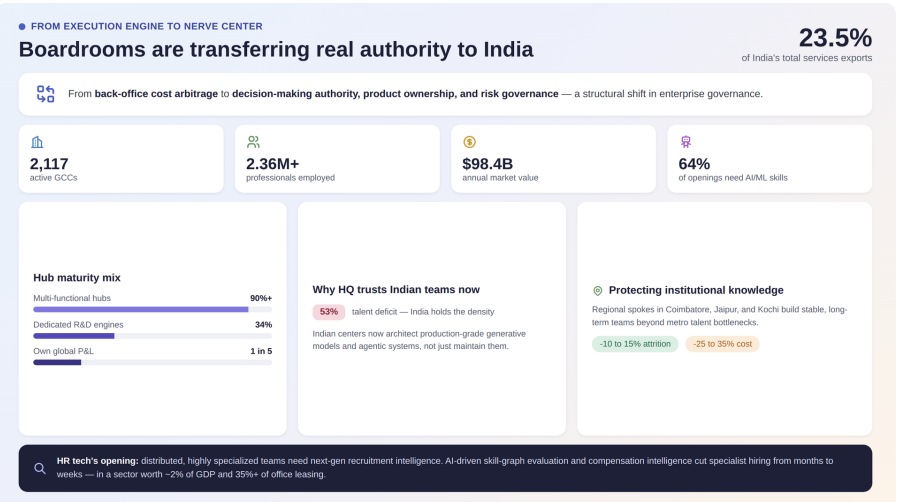
This expanding operational scope is directly supported by the massive scale of India’s GCC
ecosystem, which currently encompasses 2,117 active centers, employs over 2.36 million
professionals, and generates $98.4 billion in annual market value. Crucially, over 90% of these
centers operate as multi-functional innovation hubs, with 34% functioning explicitly as
dedicated R&D engines and one in five actively targeting global P&L accountability. Global
leadership is entrusting local units with global mandates because Indian teams now possess the
domain depth required to own core enterprise platforms end-to-end.

The rapid deployment of AI and automation serves as the primary technical accelerant behind this
trust.With 64% of all new GCC job openings requiring advanced AI or machine learning skills,
Indian units are building dedicated AI Centers of Excellence that design, evaluate, and govern
autonomous enterprise workflows. Faced with an industry-wide 53% talent deficit in specialized AI
roles, global firms realize that their Indian centers house the highest density of advanced engineering
talent capable of building production-grade generative models and agentic architectures. Rather than
delegating routine maintenance, corporate headquarters rely on Indian talent to architect the next
generation of intelligent software.
Navigating this expanded mandate requires progressive future-of-work thinking to restructure overall
talent strategy. Global organizations are moving away from measuring GCC maturity by raw
headcount growth, focusing instead on talent density and strategic influence.To sustain this capabilitydriven model without experiencing severe talent bottlenecks in primary metros, enterprises are
aggressively decentralizing operations into secondary hubs like Coimbatore, Jaipur, and Kochi.
Establishing specialized spokes in regional nodes allows GCCs to secure 10% to 15% lower attrition
rates and 25% to 35% in overall operational cost savings, creating stable engineering hubs that
protect long-term institutional knowledge.
This shift toward high-value functional ownership creates an extraordinary growth vector for HR
innovation, driving adoption for agile B2B HR startups. Managing distributed, highly specialized
teams requires next-generation recruitment and workforce intelligence platforms. High-growth HR tech
startups developing AI-driven skill-graph evaluation engines, real-time compensation intelligence tools,
contribution-based portfolio mapping, and predictive retention analytics are seeing rapid enterprise
integration.These modern tools empower talent acquisition leaders to cut specialist hiring cycles from
months down to weeks, bringing data-backed precision to executive and technical headhunting.