

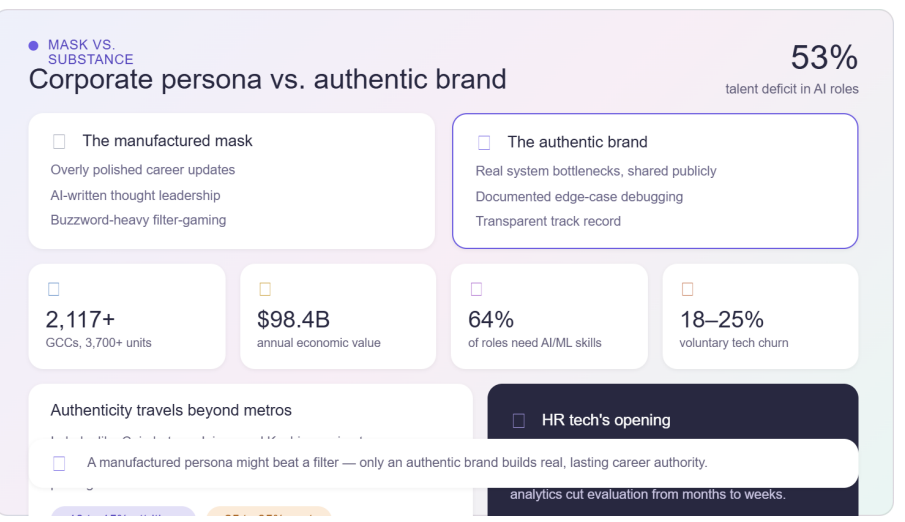
Every day, feeds are flooded with overly polished career updates, curated success stories, and buzzword-heavy
commentary designed to game algorithms. For university graduates entering the workforce and HR
startups designing modern recruitment tools, this dynamic poses an existential question. Are we
showcasing our authentic problem-solving abilities and unique perspectives, or are we simply
adopting manufactured corporate masks to pass digital filters? As global business shifts toward
higher transparency, distinguishing real professional capability from performative posting has
become a top priority for corporate boardrooms.
The urgency of this debate is closely tied to accelerating Global Capability Center (GCC) trends
across India. The country currently hosts 2,117 active GCCs operating across more than 3,700
distinct units, generating USD 98.4 billion in annual economic value and employing over 2.36
million skilled professionals. Crucially, over 90% of these centers operate as multi-functional
innovation hubs, where Indian engineering teams take direct ownership of core cloud architectures,
enterprise risk models, and global product engineering.

The widespread adoption of AI and automation across business infrastructure further complicates
this dynamic. With 64% of all new GCC job openings mandating advanced AI, machine learning,
or intelligent automation capabilities, demand for specialized engineers has created a 53% talent
deficit in AI roles, pushing voluntary tech churn to 18% to 25%. In a market where candidates
routinely use generative software to craft flawless resumes and publish AI-written thought leadership,
superficial personas are easily manufactured. True technical authority, however, cannot be
automated. Authentic personal branding emerges when professionals publicly share real-world
system bottlenecks, document complex edge-case debugging, and offer contextual insights that
standard software models simply cannot replicate.
Navigating this environment requires progressive future-of-work thinking to rebuild enterprise
talent strategy. Forward-thinking corporate leaders recognize that evaluating talent based on
superficial social media metrics or inflated resumes leads to costly hiring missteps. Progressive
organizations are adopting skill-first evaluation frameworks and expanding engineering footprints
into regional technology hubs like Coimbatore, Jaipur, and Kochi. Operating in these expanding tech
nodes allows organizations to build stable candidate pools while securing 10% to 15% lower
attrition rates and 25% to 35% in overall operational cost savings.
This authenticity gap creates an extraordinary opportunity for HR innovation, driving rapid market
adoption for agile B2B HR startups. Legacy recruitment systems that screen candidates based on
keyword density are easily gamed by synthetic content. High-growth HR tech startups developing AIdriven candidate assessment engines, contribution-based portfolio mapping, real-time compensation
intelligence tools, and predictive retention analytics are seeing rapid enterprise adoption. Modern HR
platforms empower talent acquisition managers to cut candidate evaluation timelines from months
down to weeks, enabling recruitment teams to cut through manufactured digital noise and identify
candidates with authentic domain capability and leadership potential.