
For years, university graduates and mid-level professionals relied on
static PDF documents listing technical tools, academic degrees, and project descriptions to secure
job interviews. However, in an era defined by automated candidate filtering and high-volume
recruiting, a traditional resume merely verifies that an applicant meets basic qualification thresholds.
To truly stand out, command premium compensation, and build a lasting career trajectory,
professionals must cultivate an active personal brand. While a resume introduces a candidate to the
hiring pipeline, a compelling personal brand ensures they remain unforgettable to enterprise leaders
and decision-makers.

The urgency behind building a personal brand is directly linked to shifting Global Capability Center
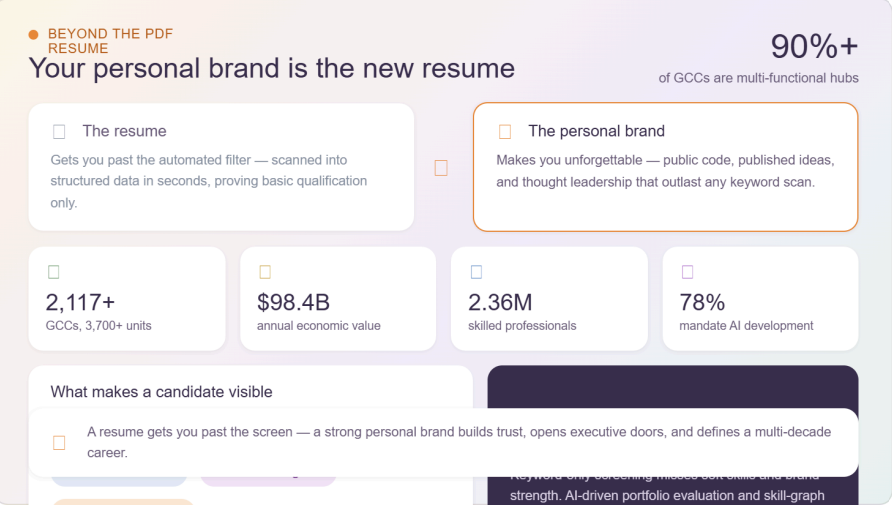
(GCC) trends. India currently hosts over 2,117 active GCCs operating across more than 3,700
distinct units, generating USD 98.4 billion in annual economic value and employing over 2.36
million skilled professionals. With over 90% of these capability centers operating as multifunctional innovation hubs, global companies are hiring individuals who can communicate
strategic ideas, author open-source code, speak at technology forums, and demonstrate clear
domain ownership.
This dynamic is further amplified by the rapid integration of AI and automation across talent
acquisition workflows. Enterprise hiring teams now utilize advanced AI platforms to scan thousands
of applications within seconds, reducing resumes to structured data points. Simultaneously, over
78% of enterprise GCCs mandate advanced AI development, actively seeking professionals who
understand autonomous agentic workflows, predictive analytics, and large language model
integration. Candidates who share public insights on artificial intelligence, post real-world code
implementations, or engage in digital technology communities stand out long before an automated
Applicant Tracking System flags their application.
Adapting to this environment requires forward-looking future-of-work thinking to reshape individual
talent strategy. Professionals can no longer afford to view their careers through a transactional lens.
Instead, progressive engineers, product managers, and quantitative analysts operate as personal
media entities, continuously showcasing their problem-solving frameworks. Navigating a competitive
tech market with average metro tech talent attrition holding between 18% and 22% means
companies are actively looking for professionals with clear industry visibility.
This shift presents a major opportunity for HR innovation, establishing a high-growth market for agile
B2B HR startups. Legacy recruitment systems that screen candidates based solely on keywords fail
to capture soft skills, leadership presence, or cultural alignment. High-growth HR tech startups
developing AI-driven candidate assessment engines, personal portfolio evaluation platforms,
automated skill-graph mapping, and real-time candidate engagement dashboards are gaining
immediate enterprise traction. These modern HR tools allow talent acquisition leaders to cut hiring
timelines from months down to weeks, helping companies evaluate authentic candidate capabilities
rather than relying on formatted PDF resumes.