

The shift in hiring expectations is fundamentally driven by accelerating Global Capability
Center (GCC) trends. India currently hosts over 1,800 active GCCs, employing nearly 2
million professionals and driving over USD 68 billion in annual enterprise value.
However, these centers are no longer operating as transactional back-office hubs; they are
taking direct ownership of global product engineering, cybersecurity architecture, and
enterprise analytics. Because GCC mandates have moved from execution to strategic
ownership, global companies are demanding deep domain knowledge rather than basic entrylevel support
This skill shortage is most acute at the intersection of AI and automation. While academic
programs cover theoretical fundamentals, enterprise engineering teams require hands-on
experience with Retrieval-Augmented Generation (RAG) pipelines, PyTorch, agentic
workflows, and cloud architecture. Recent industry data indicates a 53% talent deficit in
specialized Generative AI roles, with demand for niche AI engineers surging by 300% yearover-year. Furthermore, over 72% of GCCs report the need to reskill at least 40% of their
existing workforce to handle AI-native workflows.
To solve these talent bottlenecks, forward-looking business leaders are embedding modern
future-of-work thinking into their broader talent strategy. Rigid, degree-first hiring models
are rapidly giving way to skills-first evaluation frameworks. Instead of filtering applicants
purely by institutional credentials, progressive enterprises assess practical code execution,
real-world problem-solving abilities, and continuous learning capacity. To offset acute
shortages in tier-one metro hubs, firms are expanding into Tier-2 and Tier-3 cities while
deploying internal upskilling academies.
Traditional recruitment
workflows and manual keyword screening are incapable of bridging a 30% industry skill
gap. High-growth HR startups are filling this gap by building AI-powered skill-mapping
software, automated technical assessment platforms, and predictive attrition models. These
advanced tools enable enterprise talent acquisition teams to identify hidden candidate
potential, reduce new hire onboarding times from months down to weeks, and build datadriven workforce pipelines that align with evolving business needs.
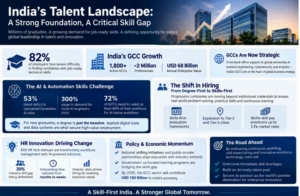
Decisive policy and economic signals further reinforce the urgent need for a skill-first
transition. National skilling initiatives, public-private education partnerships, and
government co-funded training programs are working to align university curricula with
enterprise demands. As the GCC sector prepares to contribute upward of USD 150 billion to
India’s economy by 2030, building an adaptable, AI-ready talent pool is an economic
imperative. By embracing continuous upskilling, skill-based hiring, and innovative workforce
technology, India will not only overcome its immediate skill shortages but also secure its
position as the world’s premier destination for enterprise innovation