

In India, higher education institutions are no longer operating as isolated academic campuses focused
solely on traditional degree handoffs. Instead, the nation’s vast university network has evolved into an
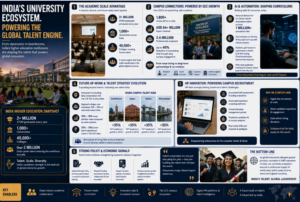
active innovation engine that directly shapes corporate growth. Producing over 2 million STEM
graduates annually across more than 1,000 universities and 40,000 colleges, India’s academic
landscape provides an indispensable foundation for global businesses. For ambitious graduates
planning their careers and HR startups designing modern workforce platforms, the university
ecosystem sits at the absolute center of global talent transformation.
The evolution of campus recruitment is closely tied to surging Global Capability Center (GCC)
trends. India currently hosts over 1,800 active GCCs, generating over USD 64 billion in export
revenue and employing nearly 2.4 million professionals. Companies sponsor specialized research labs, guest lecture series, and
capstone projects starting as early as a student’s second year. By embedding industry-relevant
curriculums early, global firms secure pre-vetted campus talent pipelines while reducing entry-level
onboarding timelines by up to 40%.

With the national
demand for artificial intelligence, cloud architecture, and data engineering talent expected to cross 1
million specialized roles, traditional computer science programs are getting rapid practical upgrades.
Leading technical institutes, including IITs, NITs, and premier private universities, are co-developing
curriculums directly with enterprise technology leaders. Students are graduating with hands-on
experience in generative AI workflows, large language model fine-tuning, and autonomous systems.
This ensures that early-career professionals enter the workforce ready to contribute to mission-critical
global engineering projects from day one.
Adapting to these shifts requires progressive future-of-work thinking and a revamped corporate
talent strategy.While Tier-1 universities continue to attract intense competition, forward-thinking
enterprises are expanding their university relationships into Tier-2 and Tier-3 educational hubs.
Regional engineering colleges across cities like Coimbatore, Jaipur, Indore, and Ahmedabad now
supply nearly 15% to 20% of new early-career hires for global centers.Tapping into these regional
campus ecosystems allows companies to access highly motivated technical talent while benefiting
from 10% to 15% lower initial attrition rates compared to hyper-competitive metro markets.
Traditional campus placement processes—often managed through
manual spreadsheets and rigid scheduling—are rapidly giving way to digital-first recruitment platforms.
EdTech and HR tech startups that build AI-powered skill-assessment tools, automated hackathon
screening platforms, virtual internship management portals, and predictive candidate-fit analytics are
finding rapid adoption among enterprise hiring managers. Modern HR technology enables employers
to evaluate real-world problem-solving capabilities over institutional pedigree, democratizing access for
graduates from non-metro universities.
Strong policy and economic signals further reinforce the integration between academia and global
industry. Directives under the National Education Policy, along with national research funding initiatives,
incentivize industry-academia collaboration, joint patent filings, and faculty immersion programs. As
global headquarters delegate greater product design and R&D mandates to Indian teams, India’s
evolving role in global enterprise strategy is deeply rooted in its university classrooms.