

By 2035, the modern enterprise will look entirely different from today, and at the center of this
transformation will be Global Capability Centers (GCCs). What began as a cost-saving
experiment in back-office support has evolved into autonomous enterprise command centers
that drive global innovation, revenue generation, and risk governance. Looking ahead to 2035,
GCCs will no longer be distant operational extensions of headquarters; they will function as the
primary brain of multinational corporations. Supported by long-term policy and economic
signals, including standardized cross-border digital tax policies and global bilateral talent
mobility agreements, the worldwide GCC market is projected to surpass $1.2 trillion in total
economic value by 2035, with total operational centers exceeding 3,500 globally.

The technological architecture of 2035 GCCs will be built entirely around hyper-scale AI and
autonomous automation. Rather than simply embedding tools into existing workflows, centers
will operate under AI-native digital operating models where autonomous agents execute over
70% of routine corporate operations. Dedicated Centres of Excellence will manage real-time
predictive risk engines, automated financial clearings, and self-healing cloud networks.
The traditional 9-to-5 job description will disappear, replaced by
outcome-focused, fluid skill networks where cross-functional squads assemble dynamically to
solve specific enterprise challenges. Retaining top-tier talent in 2035 will require organizations
to treat employees as internal partners by offering equity-linked compensation packages,
decentralized decision-making power, and continuous lifelong upskilling pathways.
Projections indicate that India will host over 60% of the world’s GCC
capability footprint, with domestic GCC revenues expected to eclipse $150 billion and employ
more than 5.5 million high-skilled professionals. Beyond tier-one tech capitals, over 35% of
new GCC hubs will operate in connected Tier-II and Tier-III cities, distributing economic
impact across regional growth corridors.
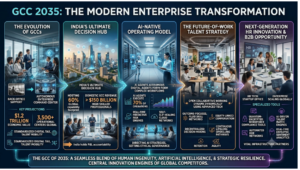
Managing hyper-automated, borderless workforces will demand nextgeneration HR innovation that renders legacy management systems obsolete. High-growth
enterprises will depend on specialized startups to provide quantum-encrypted workforce
compliance tools, AI-driven talent match engines, automated Employer of Record (EOR)
networks, and real-time employee sentiment analytics.
Companies
that continue to view offshore centers purely through a lens of operational savings will be left
behind by agile competitors who treat their capability centers as central innovation engines. As
global economic volatility continues to challenge traditional business models, the leaders,
investors, and HR innovators who build towards this 2035 paradigm today will define the
standard for enterprise excellence for generations to come.