

oday, as over 1,700 Global
Capability Centers (GCCs) operate across India generating over $64.6 billion in annual revenue,
that legacy mindset has become an enterprise liability. Favorable policy and economic signals,
including modernized safe harbour tax revisions and progressive trade frameworks, have
accelerated India’s evolution into the central strategic nerve center for multinational enterprise
strategy. To thrive in this environment, global HR leaders must unlearn rigid centralheadquarters control and recognize that India is no longer an offshore execution arm, but a
primary driver of global corporate value.
Modern GCCs host roughly 45% of the world’s global capability center talent base,
with industry projections targeting $105 billion in market value by 2030. Indian talent is no
longer simply maintaining existing systems; nearly 20% of GCCs now hold direct strategic
decision-making authority over global products, IP creation, and enterprise platforms. Treating
local teams as passive implementers creates severe retention bottlenecks and stifles
innovation.
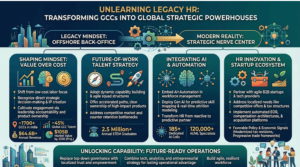
Another critical lesson involves adopting future-of-work thinking in talent strategy and
retention. Western HR playbooks often rely on slow, linear career progression and static job
descriptions. In India’s hyper-competitive market, where top engineering talent is aggressively
courted, global HR must pivot toward dynamic capability building and agile squad structures.
With India producing over 2.5 million STEM graduates annually, the operational priority is not
basic headcount scaling, but continuous upskilling.
Integrating AI and automation into daily human resources operations requires a similar
operational reset. Legacy HR operations often treat digital platforms as administrative
databases rather than strategic engines. In contrast, modern GCCs operate as core digital
powerhouses, hosting over 185 dedicated AI Centres of Excellence and employing more than
120,000 AI and machine learning specialists. To support these high-tech teams, global HR
must embed AI + automation directly into workforce management. Deploying generative AI
platforms for predictive skill mapping, automated candidate screening, and real-time attrition
risk modeling transforms human resources from a reactive administrative unit into a predictive
talent partner.

Off-the-shelf global HR software frequently fails to address the operational nuances of the
Indian ecosystem, such as hyper-competitive offer-to-join dynamics and localized tax
structures. Forward-thinking enterprise leaders are actively partnering with HR tech startups
to implement automated Employer of Record (EOR) frameworks, tax-optimized compensation
architectures, and borderless talent acquisition platforms. By equipping talent teams with
flexible scaling tools and automated compliance, HR innovation turns workforce logistics into a
strategic defense mechanism against global market volatility.
Unlearning obsolete global HR playbooks is a necessary step toward unlocking the true
strategic capability of modern global centers. As India solidifies its position as an enterprise
innovation powerhouse, business leaders who replace top-down governance with localized
trust and empowerment will gain a lasting operational advantage. By combining modern HR
tech, predictive talent analytics, and an entrepreneurial workforce strategy, global
organizations can build agile, future-ready operations capable of navigating any global
disruption.