

Global supply chains, economic volatility, and sudden geopolitical shifts have repeatedly shown
us how vulnerable traditional business models can be. When the next global disruption hits,
multinational corporations will not be able to rely on passive cost-cutting. Instead, the real
resilience layer is emerging within Global Capability Centers (GCCs). Over the past decade,
GCCs have quietly transformed from basic back-office support into strategic command centers
that protect enterprises against macroeconomic instability
What used to be an offshore cost-arbitrage model is now a global engine for value creation, with
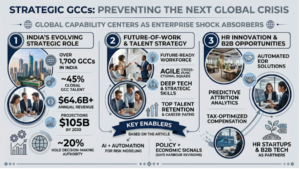
India hosting roughly 45% of the world’s GCC talent base. The numbers tell a clear story: India’s
GCC ecosystem currently generates over $64.6 billion in annual revenue and employs nearly 2
million skilled professionals, with industry projections targeting $105 billion by 2030. More
importantly, nearly 20% of GCCs now hold direct strategic decision-making authority over
global products and platforms

To prevent future operational breakdowns, modern GCCs are embedding generative AI and
automated workflows into the foundation of enterprise management. Rather than viewing
automation merely as a tool for efficiency, future-ready centers use AI platforms to automate
routine execution and predict supply chain or financial risks in real time. When a crisis occurs,
an automated, data-driven operational engine ensures that core risk modeling, digital banking
journeys, and enterprise cybersecurity remain active.
. During times of crisis, organizations often suffer from
skill bottlenecks, high burnout, and rapid knowledge loss. Modern GCCs combat this by building
agile, cross-functional squads trained in deep tech, cloud architecture, and strategic problemsolving. By offering direct ownership of global products and high-impact career trajectories,
GCCs have turned into powerful talent hubs. Retaining top-tier talent through continuous
upskilling and flexible work models creates an adaptable workforce that can pivot rapidly
whenever market dynamics demand a strategic shift.
Building resilient GCC teams requires
modern workforce architecture—ranging from automated Employer of Record (EOR) solutions
and predictive attrition analytics to tax-optimized compensation structures and borderless
hiring platforms. Startups that deliver specialized tools for talent acquisition, leadership
succession, and cross-border team engagement will become vital partners for enterprise leaders.
By equipping HR teams with real-time talent insights and flexible scaling tools, HR innovation
turns workforce planning into a proactive defense mechanism against future shocks.
Preventing the next global crisis is not about predicting every market disruption; it is about
building enterprise structures that are agile enough to withstand any outcome. As GCCs solidify
their position as innovation powerhouses, they provide global businesses with the operational
depth, technology readiness, and human capital required to weather unpredictable storms.
Enterprise leaders and HR innovators who invest in this evolving ecosystem today are not just
scaling operations—they are building the ultimate shock absorber for tomorrow’s global economy