

One of the biggest drivers behind this shift is the rapid evolution of Global Capability Centres
(GCCs). India is now home to more than 1,900 GCCs, employing over 2 million professionals
across technology, finance, engineering, cybersecurity, product development, and research
functions. These centres are no longer limited to executing predefined tasks. Instead, they are
leading enterprise-wide initiatives, building global products, managing AI programmes, and
influencing strategic business decisions
The rise of artificial intelligence and automation is further strengthening India’s position in global
boardrooms. Rather than replacing talent, AI is changing how work is performed and where value
is created. Indian professionals are increasingly responsible for building AI models, developing
intelligent automation solutions, managing cloud infrastructure, and designing digital products
used by customers worldwide.

With one of the world’s youngest workforces and over 1.5 million engineering graduates
entering the workforce every year, the country provides enterprises with access to a
continuously expanding pool of technical talent. As hybrid work, digital collaboration, and AIenabled workplaces become the norm, India’s ability to support distributed global teams gives it
a significant competitive advantage.
Traditional hiring models are no longer sufficient for organisations building AI-first businesses.
Companies now require faster hiring, continuous upskilling, predictive workforce planning, skills
intelligence, and personalised employee development. HR technology platforms are responding
by using AI-powered recruitment, automated skills assessments, workforce analytics, and internal
talent marketplaces to help enterprises identify and develop future-ready employees. As GCCs
continue expanding, HR innovation will become one of the biggest competitive differentiators for
organisations operating in India.
Companies are investing heavily in
leadership development, digital capability building, university partnerships, and continuous
learning programmes to prepare employees for emerging technologies. Skills such as AI
engineering, cybersecurity, cloud computing, data science, product management, and digital
leadership are becoming central to enterprise growth strategies. Organisations that build strong
talent ecosystems today will be better positioned to compete in tomorrow’s economy
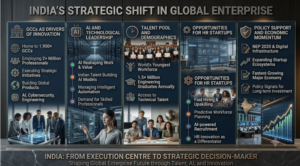
India remains one of the fastestgrowing major economies, while multinational companies continue diversifying global supply
chains and expanding strategic operations beyond traditional markets. As enterprises search for
stable, scalable, and innovation-driven business environments, India increasingly stands out as a
preferred destination. The combination of demographic strength, technical capability, policy
support, and a mature GCC ecosystem creates a unique competitive advantage that very few
countries can replicate.
For HR startups, business leaders, and enterprise decision-makers, this shift represents one of
the most significant opportunities of the decade. The organisations that invest early in talent, AI
capabilities, workforce innovation, and GCC transformation will be best positioned to benefit
from India’s growing influence in the global economy. The conversation in international
boardrooms is no longer about whether India should play a strategic role. It is about how much of
the enterprise’s future can be built from India