

India currently produces over 1.5 million engineering graduates annually. That number is already
the largest STEM output of any country in the world, and it is already reshaping how global
enterprises think about where to build their most important capabilities. But there is a scenario
emerging from the intersection of policy ambition, demographic momentum, and AI-enabled
education that deserves serious strategic attention .
The foundation for this scenario is already being laid. The National Education Policy 2020 has
set an ambitious target of increasing the Gross Enrolment Ratio in higher education from 27
percent to 50 percent by 2035 — which would add tens of millions of additional students to
India’s higher education system over the next decade. Simultaneously, the government’s push to
expand technical education capacity through new IITs, NITs, and state engineering institutions is
creating physical infrastructure for significantly larger graduate cohorts.
Add to this the explosion of online and hybrid learning platforms — including Indian edtech
companies like Byju’s, Unacademy, and upGrad which collectively reach tens of millions of
learners — and the upstream capacity of India’s technical talent pipeline is growing at a pace that
the mainstream narrative about India’s education system has not yet fully absorbed.
AI and automation are the most powerful amplifiers of this scenario. AI-enabled tutoring systems,
personalised learning pathways, and automated skills assessment tools are dramatically
improving the productivity of the education system — enabling higher quality outcomes from a
broader base of students without requiring proportional increases in qualified faculty. In a
country where one of the biggest constraints on education quality has historically been the
availability of great teachers, AI-powered education infrastructure is a structural game-changer.
On the supply side, a larger graduate cohort means more talent available at every experience level — which could ease
the intense competition for mid-career AI and engineering professionals that is currently driving
significant salary inflation in India’s major tech hubs. On the quality side, the challenge is ensuring
that a larger volume of graduates maintains the depth and relevance that global enterprises
depend on — which is where industry-academia partnership programmes, corporate upskilling
investments, and GCC talent development infrastructure become critically important.
For HR startups and talent innovators, the 10 million graduate scenario is the most important
long-term planning horizon available. The tools, platforms, and frameworks that will be needed to
find, assess, develop, and deploy talent at that scale do not yet exist in adequate form — and the
organisations that build them now, calibrated to India’s specific educational context and
enterprise requirements, will have a structural head start when the volume arrives.
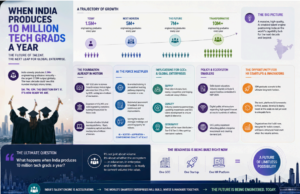
The question of what happens when India produces 10 million tech grads a year is ultimately a question about
whether the ecosystem around that talent — in education, in enterprise, and in HR innovation — is
ready to convert volume into value. That readiness is being built right now, one GCC, one startup,
and one HR platform at a time.