

The automation momentum inside India’s GCC ecosystem is genuinely extraordinary. Over 83
percent of India-based GCCs are investing in Generative AI, and the investment is accelerating
rather than plateauing. Across functions ranging from software engineering and financial analysis
to customer intelligence and regulatory compliance, AI tools are being deployed at a pace that is
compressing what used to take days into minutes. The productivity gains are real, measurable,
and in many cases transformative.
When AI tools take over tasks that previously required deep human expertise — regulatory interpretation, risk
assessment, code architecture decisions, client relationship management — the humans who
used to do those tasks stop developing the depth that made them valuable in the first place.
Junior professionals who would have spent two or three years developing judgment through
hands-on experience are instead supervising AI outputs they do not fully understand.

The immediate productivity gain is visible. The long-term capability degradation is invisible until
it becomes a crisis. India’s GCC workforce of 2.4 million professionals is the strategic asset at
the heart of the GCC value proposition — and automation that erodes the depth of that
workforce is not a productivity strategy. It is a long-term liability.
The second concern is the relationship and context problem. GCCs that are highly automated
can become extraordinarily efficient at processing known problems — and increasingly brittle
when they encounter situations that fall outside the parameters their AI systems were trained on.
The global business environment is not a stable, predictable system. It is a complex, rapidly
changing environment where the most valuable organisational capability is the ability to respond
intelligently to novel situations.
A GCC that can process ten times the analytical output with
the same headcount is delivering genuine commercial value — and the enterprises funding these
investments are seeing returns that validate the thesis. The question is not whether automation is
delivering value. It clearly is. The question is whether the pursuit of that value is creating blind
spots that will cost enterprises dearly in the medium term.
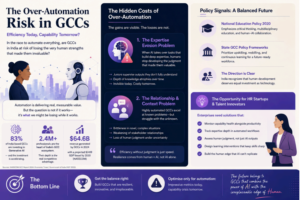
For HR startups and talent innovators, the over-automation debate is both a warning and a
commercial opportunity. Enterprises that are automating aggressively need tools that can
monitor capability development alongside productivity metrics, track the health of human
judgment and expertise within automated workflows, and design learning interventions that
keep human skills sharp even as AI tools take on more routine work. The organisations that get
the human-automation balance right will build GCCs that are genuinely resilient, genuinely
innovative, and genuinely valuable over the long term.