
The combination of digital infrastructure, AI-enabled collaboration tools, and a genuinely global
talent market has created a new geography of work where the location of decision-making,
innovation, and execution is being fundamentally reorganised. And India is sitting at the centre of
that reorganisation in a way that has profound implications for every enterprise, every HR leader,
and every workforce innovator paying attention.
The old model placed strategic work in expensive cities in the United States, United Kingdom, and
Western Europe, and routine work in lower-cost locations. What is happening now is more
interesting and more disruptive than a simple cost arbitrage shift. Global enterprises are
discovering that the distinction between strategic work and routine work is collapsing — partly
because AI is automating the routine layer, and partly because the talent available in markets like
India has matured to the point where it can credibly own work at every level of the value chain

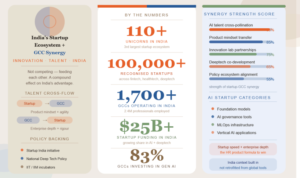
India’s GCC ecosystem, which now encompasses over 1,700 centres employing 2.4 million
professionals, is the most concrete expression of this new geography. These are not backoffices. The
fact that this work is happening in Hyderabad or Pune rather than New York or London is not a
compromise. For many enterprises, it is a deliberate strategic choice that gives them access to
better talent at a more sustainable cost structure, embedded in a more favourable time zone for
global coverage.
AI and automation are reshaping the geography of workflows in two simultaneous directions. On
one hand, AI tools are enabling teams in India to take on more sophisticated, more autonomous,
and more globally integrated work than was possible before — because the collaboration friction
that once made remote strategy work impractical has been dramatically reduced by intelligent
platforms, real-time translation capabilities, and AI-assisted communication tools
For HR startups and talent strategy leaders, the new geography of global workflows creates a
clear and expansive product mandate. Enterprises managing distributed, globally integrated
workflows need workforce orchestration tools, cross-timezone productivity frameworks,
skills mapping platforms that work across geographies, and leadership development
programmes designed for globally distributed teams. The organisations building these tools
with genuine India context — understanding how Indian teams collaborate, lead, and deliver in
global workflow environments — will be building exactly what the market needs.