

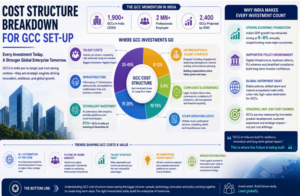
India has become the preferred destination for building these strategic hubs. Today, India is home
to over 1,900 GCCs, employing more than 2 million professionals, and the ecosystem is
expected to grow to 2,400 GCCs by 2030. What was once viewed as a cost-saving initiative has
evolved into a long-term business strategy focused on innovation, digital transformation, and
global growth. For business leaders, HR startups, and talent partners, understanding the cost
structure of setting up a GCC is essential because every investment decision directly impacts
future scalability and competitiveness.
India produces over 1.5 million engineering graduates every year, along with thousands of
finance, business, legal, analytics, and design professionals who are ready to support global
operations. Companies are no longer hiring only for technical expertise—they are investing in
adaptable professionals who can collaborate across geographies, work with AI-powered tools,
and contribute to innovation. This shift reflects the future of work, where continuous learning and
digital skills are becoming just as important as traditional qualifications

Infrastructure is another key component of GCC costs. This includes office space, IT
infrastructure, cybersecurity systems, cloud platforms, collaboration tools, and business
continuity planning. While hybrid work has reduced the need for extremely large office spaces,
enterprises continue investing heavily in secure digital workplaces that allow employees to
collaborate seamlessly from anywhere. Modern GCCs are increasingly designed as technologyenabled innovation centres rather than traditional office environments
Technology investment has become one of the fastest-growing areas of GCC expenditure.
Artificial Intelligence, automation, cloud computing, data analytics, and intelligent workflow
platforms are no longer optional—they are becoming core business capabilities. Industry reports
show that over 83% of India’s GCCs are actively investing in Generative AI to improve
productivity, enhance decision-making, and automate repetitive tasks. Rather than replacing
employees,
As competition for
skilled professionals increases, organisations are spending more on employer branding, employee
engagement, leadership development, workforce planning, and internal mobility programmes. The
goal is no longer simply attracting talent but building an organisation where employees want to
stay and grow. This creates significant opportunities for HR startups developing AI-powered
recruitment platforms, workforce analytics solutions, employee experience tools, and skills
intelligence platforms.
Operating costs are significantly lower than in many developed markets while maintaining access
to highly skilled professionals, mature technology ecosystems, and expanding digital
infrastructure. More importantly, GCCs are no longer measured purely by cost savings. Global
enterprises increasingly evaluate them based on innovation output, product development,
customer experience, research capabilities, cybersecurity expertise, and strategic decisionmaking.
Companies are establishing GCCs not only to reduce operational expenses but to access
specialised talent, accelerate digital transformation, strengthen resilience, and support global
expansion. The combination of AI adoption, workforce capability, supportive policies, and a
rapidly growing innovation ecosystem positions India as one of the world’s most important
enterprise destinations.