

Two of the most powerful forces shaping India’s economy right now are developing largely in
parallel — and the organisations that understand how they interact will have a significant strategic
advantage over those treating them as entirely separate conversations. India’s startup ecosystem
and its GCC landscape are not in competition. They are feeding each other in ways that are
creating a compound effect on India’s innovation capacity, workforce quality, and global
enterprise attractiveness.
India is the world’s third largest startup ecosystem, home to over 110 unicorns and more than
100,000 recognised startups across sectors ranging from fintech and healthtech to deeptech,
climate technology, and enterprise SaaS. This ecosystem has produced something that is
genuinely difficult to manufacture through traditional corporate training — a generation of Indian
professionals who have worked in high-velocity, high-accountability, innovation-led environments
where they owned outcomes end to end.

GCC professionals with deep expertise in enterprise AI, cloud infrastructure, or financial risk
systems regularly move to startups where they apply that technical rigour in faster-moving
commercial contexts. Startup founders and operators who have built products from zero to scale
move to GCCs where they inject product thinking, user-centricity, and entrepreneurial urgency
into large organisation environments.
This cross-pollination is generating a cohort of Indian professionals who combine enterprise
depth with startup agility — a combination that India is producing at a scale no other market is
coming close to matching. For GCC talent teams, tapping into this cross-pollinated talent pool is
one of the most effective differentiation strategies available.
AI is the domain where the startup-GCC synergy is most productive and most commercially
significant. India’s AI startup ecosystem — companies building foundation models, AI
governance frameworks, MLOps infrastructure, and vertical AI applications across
healthcare, finance, and manufacturing — is creating a technology environment that GCCs can
draw on, partner with, and learn from in real time.
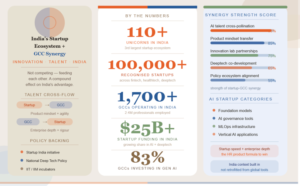
Several major GCCs have established formal startup partnership programmes, corporate venture
capital arms, and internal innovation labs specifically to access the velocity and creativity that
startups generate. India attracted over $25 billion in startup funding in recent years, with a
growing share directed toward AI and deeptech — and the talent and technology that investment
produces flows back into the GCC ecosystem in ways that raise capability levels across the
board.
For HR startups and workforce innovators, the GCC-startup synergy is both a market and a
model. The GCC organisations managing large India operations need partners that bring startup
speed and creativity alongside enterprise-grade reliability and depth. The HR innovators who can
demonstrate both — products built with genuine India context, robust enough for enterprise
procurement, and fast enough to keep pace with a rapidly evolving talent market — are the ones
who will earn the most trusted and most valuable positions in India’s GCC ecosystem.