

Every country has something that gives it an edge in the global economy. For India, that
advantage has always been its people. Today, that advantage is becoming even stronger because
of the country’s young workforce, growing digital skills, and rapid adoption of new technologies.
As businesses across the world rethink where they build talent and innovation, India is no longer
seen only as a destination for cost savings. It is becoming the global workforce engine that
powers business growth, technology, and enterprise transformation.
One of India’s biggest strengths is its demographics. With a working-age population of more
than 900 million and a median age of just 28 years, India has one of the youngest talent pools in
the world. Every year, the country produces over 1.5 million engineering graduates along with
millions of professionals from business, finance, healthcare, and technology backgrounds. This
continuous flow of skilled talent gives global organisations the confidence to build long-term
operations in India while ensuring access to future-ready professionals.

Artificial Intelligence and automation are
changing how organisations hire, train, and manage talent. Instead of replacing people entirely, AI
is creating demand for professionals who can work alongside intelligent systems, analyse
complex problems, and make strategic decisions. According to industry reports, over 83% of
India-based GCCs are investing in Generative AI initiatives. This means organisations are
actively building AI capabilities in India, creating new opportunities for highly skilled professionals
while increasing demand for continuous learning and upskilling
For HR startups, these changes create enormous opportunities. Traditional recruitment alone is
no longer enough to meet enterprise needs. Businesses now require smarter HR solutions that
can identify emerging skills, predict workforce demand, improve employee experience, and
support internal mobility. AI-powered hiring platforms, workforce analytics, skills intelligence,
learning technologies, and talent mapping solutions are becoming critical for organisations that
want to remain competitive.
Economic signals also point towards sustained growth. Global organisations are increasingly
diversifying their operations, strengthening supply chains, and investing in digital transformation.
India offers a combination that very few countries can match: a large talent base, strong technical
education, improving digital infrastructure, supportive government policies, and a mature GCC
ecosystem. These factors make India an attractive long-term partner for enterprises looking to build resilient and innovation-driven operations.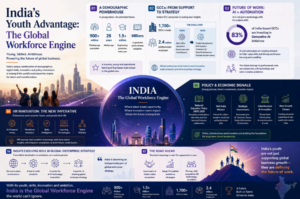
India’s evolving role in global enterprise strategy is becoming clearer every year. It is no longer
simply a place where companies outsource work. It is where they develop products, build AI
capabilities, create global technology platforms, and shape business strategy. As organisations
continue to compete for skilled talent worldwide, India’s youth advantage will remain one of its
greatest economic strengths.
For HR leaders, talent innovators, and enterprise decision-makers, this shift represents more than
a workforce trend. It signals a long-term transformation in how global businesses build
capabilities. Companies that invest early in India’s talent ecosystem, embrace AI-enabled
workforce strategies, and partner with innovative HR technology providers will be better prepared
for the future of work. India’s young workforce is not only supporting global business growth—it is
helping define what the future workforce will look like.