

Ask any GCC leader in India what keeps them up at night, and compensation will be near the
top of the list. Not because they are underpaid — in many cases, senior GCC leaders today
earn more than they have at any point in the history of offshore operations. The challenge is
knowing whether what they are being paid is right relative to the market, relative to their
global peers, and relative to the strategic value they are delivering.
The market for GCC leadership talent in India has moved faster than most compensation
frameworks have been able to keep pace with. Five years ago, a GCC Managing Director or VP
of Engineering might have been compensated primarily in cash with a modest bonus and
limited equity participation. Today that picture looks completely different. A senior GCC
leader at MD or VP level in a top-tier organisation can command total compensation of ₹1.5
crore to ₹4 crore per annum, with equity, long-term incentive plans, and global bonus
schemes forming an increasingly significant share of that total.

The fundamental problem with current benchmarking approaches is that they were not
designed for the GCC context. Most salary surveys and compensation platforms are
calibrated either to domestic Indian market norms or to global market standards — and GCC
leaders occupy a genuinely distinct position that sits between both. They are delivering value
at a global level while being priced in a local market context.
The resulting mismatch creates persistent inequity that is visible to the people experiencing
it even when it is invisible to the organisations creating it. Over 40 percent of GCC leaders in
recent surveys cited inadequate compensation benchmarking as a significant concern in their
organisations’ talent retention strategies. That is not a minor data point — it is a clear signal
that the tools being used to make compensation decisions are not fit for purpose.
A head of Generative AI for a global financial institution based in Bangalore is doing the same
job as their counterpart in London or New York. The value they deliver is equivalent. The
compensation gap, however, can still be substantial — and in a market where over 83 percent
of GCCs are investing in Generative AI, the demand for these profiles is intense enough to
give talented professionals real leverage when they choose to use it.
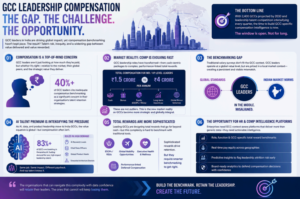
Total rewards architecture is evolving in response to these pressures. Leading GCCs are
moving beyond cash-heavy packages to include ESOPs, restricted stock units, global
mobility opportunities, executive health and wellness benefits, and performance-linked
deferred compensation. This sophistication in rewards design is necessary to compete
effectively — but it also creates complexity that most existing HR technology platforms are
not equipped to model or benchmark accurately.
For HR startups and compensation intelligence platforms, the GCC leadership benchmarking
gap is one of the most clearly defined and commercially actionable problems in the market.
Enterprises do not need more generic salary data. They need role-specific, function-specific,
and GCC-context-aware total reward benchmarks that account for the strategic nature of
leadership work being done in India.
They need platforms that can model pay equity across geographies in real time, flag emerging
leadership attrition risk before it becomes a departure conversation, and give CHROs the
analytical confidence to defend compensation decisions at board level. With 2,400 GCCs
projected by 2030 and leadership talent competition intensifying every quarter, the window
to build this capability and establish market leadership is open right now — and it will not stay
open indefinitely