

Compensation in India’s GCC ecosystem is undergoing one of the most significant structural
shifts in its history. For decades, the pay gap between Indian professionals and their global
counterparts doing equivalent work was treated as a given — a feature of the model rather
than a flaw. That assumption is being challenged with increasing force, and the organisations
that are paying attention to how compensation benchmarks are evolving will be far better
positioned to attract, retain, and motivate the talent their GCC strategy depends on. Pay
parity is no longer a philosophical debate.
Senior technology professionals
in Bangalore and Hyderabad are now commanding packages that would have seemed
extraordinary a decade ago. A director-level AI engineer or data science leader in a top-tier
GCC can earn between ₹60 to ₹1.2 crore per annum, with equity, bonuses, and benefits
pushing total compensation significantly higher. These numbers are not outliers — they
reflect a broader market reality driven by intense competition for a finite pool of high-skill
talent.

Every new GCC that opens is fishing in the same
pool of senior professionals, and basic supply and demand economics are doing their work.
On the transparency side, platforms like LinkedIn, Glassdoor, and AmbitionBox have made
salary benchmarks widely accessible, which means professionals know what they are worth
and are increasingly willing to walk if they feel undercompensated. Average attrition in highskill GCC roles runs at 18 to 22 percent annually, and pay dissatisfaction is consistently cited
as one of the top three reasons for departure.
Professionals with genuine expertise in Generative AI, large language model
deployment, AI governance, and machine learning engineering are commanding packages
that in some cases approach or match what equivalent roles pay in London or Singapore. The
global scarcity of this talent means that Indian professionals in these areas have real
leverage, and leading GCCs are responding by creating AI-specific compensation bands that
sit above their standard salary structures.
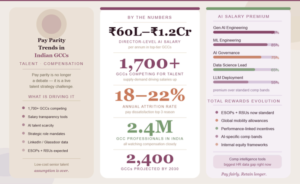
Pay parity conversations are also expanding beyond base salary into total rewards
architecture. Global enterprises are increasingly bringing ESOPs, restricted stock units,
global mobility allowances, and performance-linked incentive structures into their India
GCC compensation packages. This reflects a recognition that attracting senior talent in India
increasingly requires the same sophistication of rewards design that is applied to equivalent
roles in the US or UK
As GCC teams take on more strategic mandates — leading product development, owning AI
research, running global risk functions — the case for paying them at rates that reflect the
value they deliver becomes impossible to ignore. The organisations that embrace pay parity
proactively, backed by strong compensation data and genuine equity frameworks, will build
GCC cultures that attract the best talent the market has to offer